In 1802 legislative authority was granted the Salem Turnpike and
the Chelsea Bridge Corporation to construct, maintain and operate a
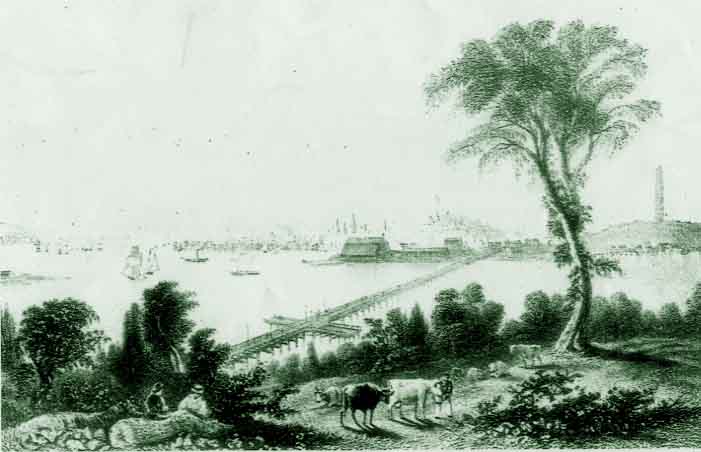
toll bridge between Chelsea and Charlestown. In 1803 the first bridge
was built spanning the Mystic River connecting Chelsea and Charlestown.
This bridge was a toll bridge. Abel Gardner was the toll collector
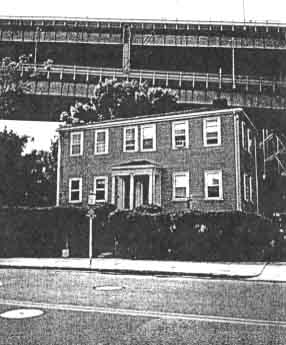
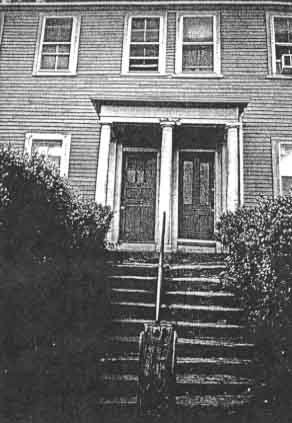
on the bridge. He built a house on lower Broadway near the enterance
to Admirals Hill in 1805. It became known as the Gardner House and is
still standing today, the second oldest house in Chelsea.
The bridge provided a 32 foot roadway which was narrowed down to
16 feet at the draw spans across the North and South channels. Each
draw span provided a 30 foot clear waterway.
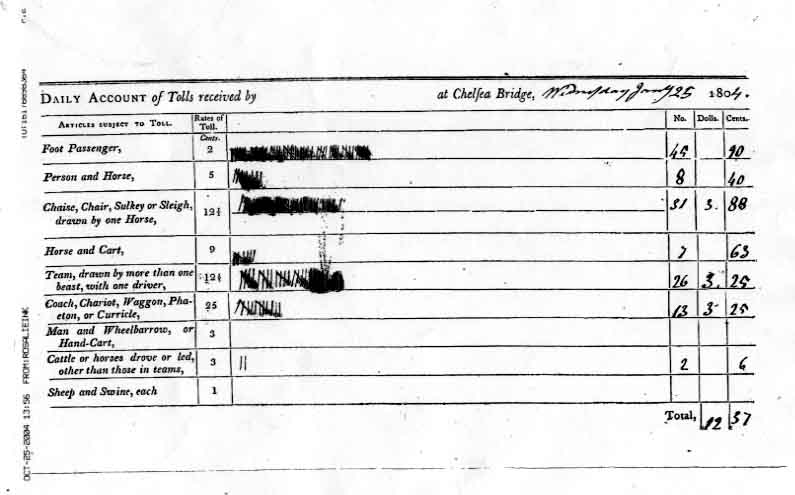
Daily account of tolls received at the Chelsea
Bridge on January 25, 1804.
Click to enlarge
In November of 1869 the tolls were abolished and passage was
declared free.
The draw span over the north channel was rebuilt in 1873 to a
length of 110 feet and a 36 foot roadway width. This became necessary
because of growing boat traffic to businesses and manufacturing firms
beginning to locate along the shores of the Mystic, Island End and
Malden Rivers.
Additionally, with the advent of steam boats which
were growing in size. In 1880 the draw span near Charlestown was
designated the “Chelsea South Bridge” and the draw span
near Chelsea was designated the “Chelsea North Bridge”.
In 1834 a free bridge was constructed from Chelsea Street
East Boston to Chelsea. This was known as the Chelsea Street Bridge.
Although rebuilt many times it remained in the same location.
The Meridian Street Bridge extending from Meridian Street
East Boston to Pearl Street Chelsea was built in 1856. In 1832 the
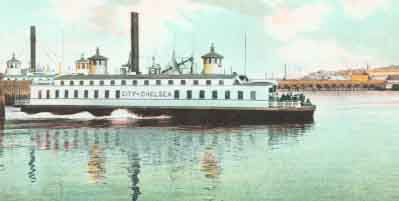
Winnisimmet Ferry Company converted to running new steam ferries
replacing the old sailboats. The construction of bridges had hurt the
ferry service along with the electric trolley and eventually the
motorized truck and auto. The ferry came to an end in 1917 after 286
years of service to the public.
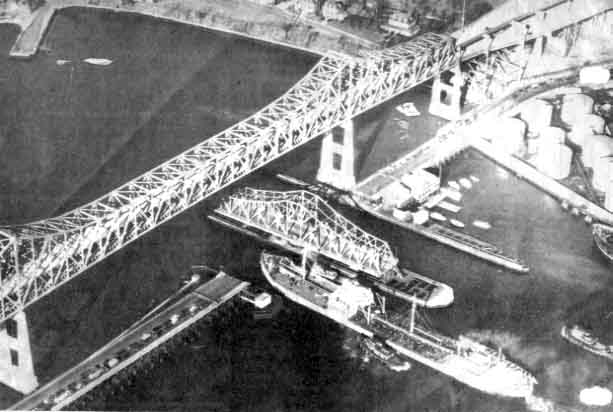
As time progressed the firms grew in number and so did the river
traffic going through the Old North Draw Bridge. With the invention
of motorized vehicles land traffic going over the bridge also
increased. The continuous opening of the drawbridge and the
increasing number of vehicles caused traffic jams that backed up in
Chelsea all the way to Chelsea Square. Something had to be done to
alleviate the problem.
In the early twenties efforts were being made to ease the
congestion mostly with plans for a new and suitable bridge. Nothing
definite ever came of it. Due to the various emergency situations
especially during WWII, the State Highway Commission recommended the
construction of a new bridge. It was this proposal that was used by
the legislature to authorize the creation of the Mystic River Bridge Authority.
Vigorous but unsuccessful efforts to block construction or to
change the route of the bridge were attempted. Public hearings,
protest meetings, visits to the State House and trips to Washington,
DC occurred but all to no avail.
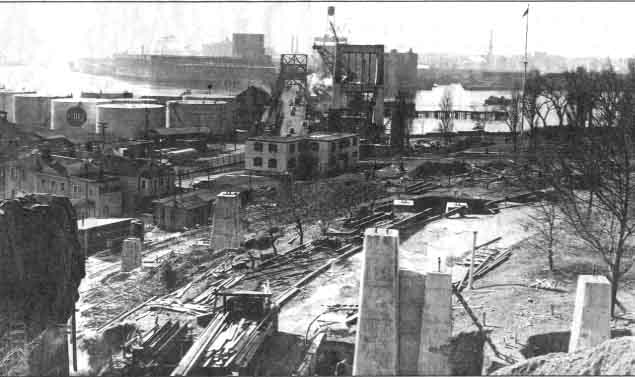
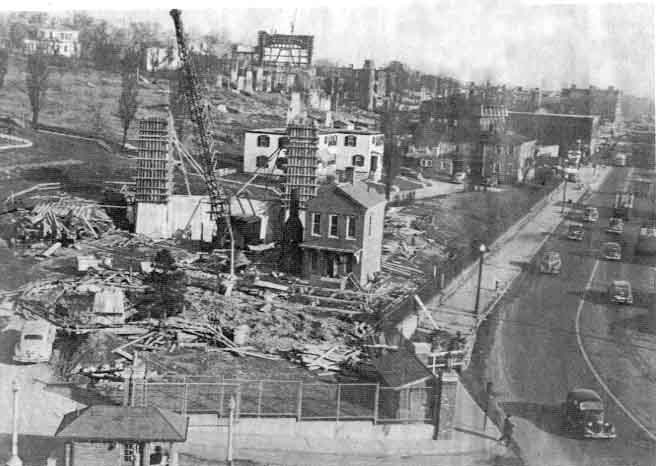
Ground was broken on April 12, 1948 the 40th anniversary of the
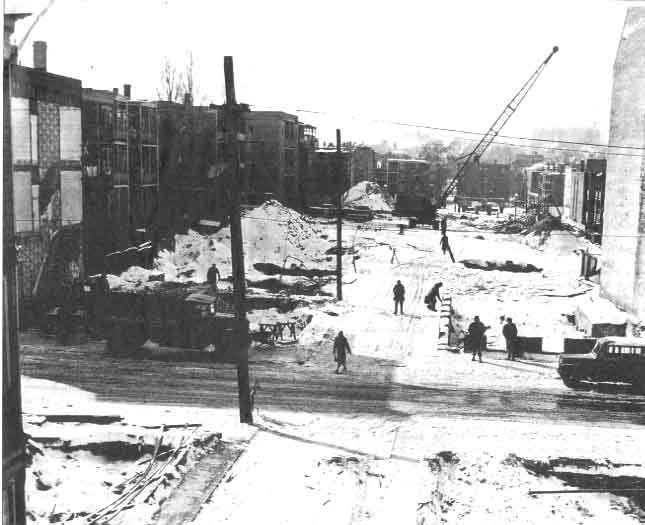
Chelsea Fire of 1908. Seventy homes were moved to Gilooly road and
Webster Ave. The homes that could not be moved were torn down. The
construction affected hundreds of people.
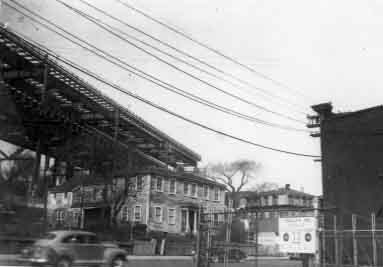
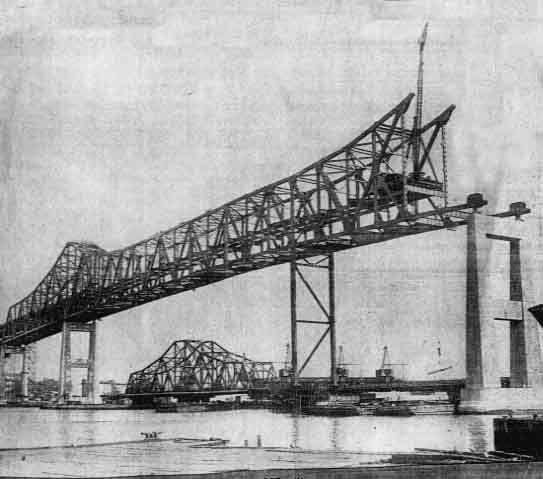
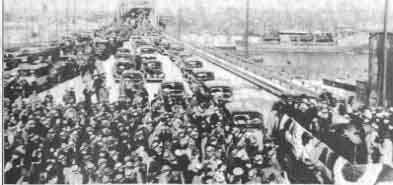
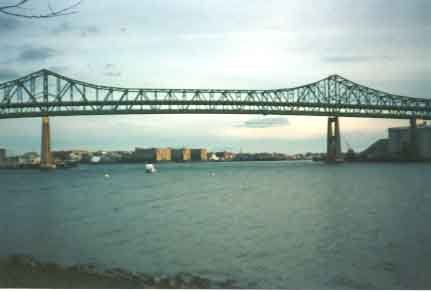
The Mystic River Bridge was built at a cost of $27 million and was
officially dedicated on February 25, 1950. The structure extends
11,906 feet from grade to grade. It is a double deck cantilever
bridge with a roadway forty two feet wide. The main span construction
took over 50,000 tons of steel and is 800 feet long. The bridge
stands 258 feet at its highest point and has a clearance of 135 feet
over mean high water. Just under 30 million vehicles cross the bridge
annually. In 1950, the first year the span opened, 8.6 million
vehicles travelled over it.
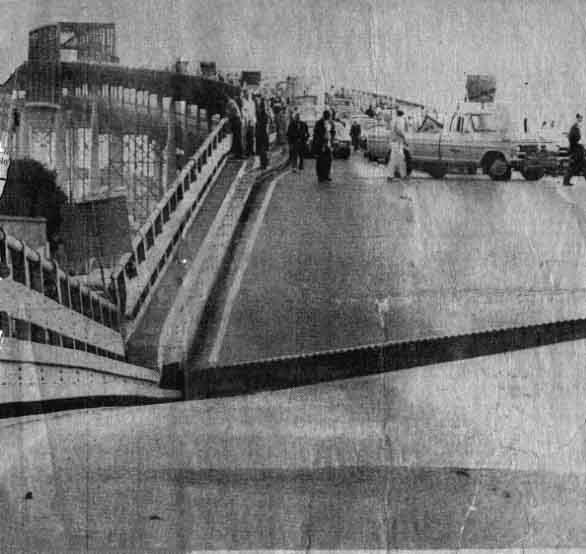
On Tuesday morning September 11, 1973 at 6:05 AM. An 18 wheel
trailer truck weighing about 60 tons with a load of gravel lost
control on the lower level and tore out a supporting stanchion. This
resulted in the collapse of a 120 foot section of the upper level.
The accident occurred about 300 feet from the Charlestown off ramp
creating a massive traffic jam. The bridge was closed down on both
levels for several months. The driver was trapped and died in the
accident. He was finally cut loose by Chelsea Ladder 1 “Jaws of Life”.