Where Broadway now lies, Indians once followed a forest trail.
George Washington and Revolutionary War soldiers marched along the
street when it was still a country lane. Much later, Abraham Lincoln
spoke in Chelsea Square, and Sarah Bernhardt performed at the Academy
of Music. Stage coaches and carriages, trollies and automobiles
travelled on Broadway, as Chelsea grew from a settlement at the ferry
landing to a thriving city. The buildings lining the street from
Bellingham Square to Chelsea Square are a visual record of Chelsea’s
history.
Broadway forms one segment of a route that has connected Boston
with the North Shore for over 350 years. Throughout the 17th and 18th
centuries Boston travelers would catch the Winnisimmet Ferry to the
Chelsea shore. At the ferry landing, they could continue on horseback
along a meandering road leading north that was originally based on
Indian trails.
Until the 19th century Chelsea remained a rural area composed of
farms and a small settlement near today’s Revere Beach Parkway. In
1803 Broadway was formally laid out as a part of the new Salem
Turnpike leading from the Winnisimmet Ferry to Salem. Livery stables
and an inn at the ferry landing served the increasing number of
people who travelled on the new road.
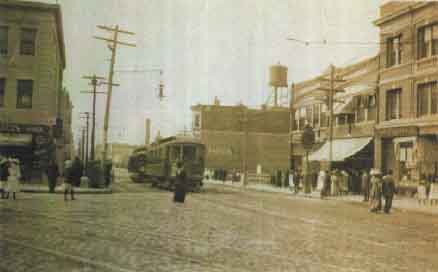
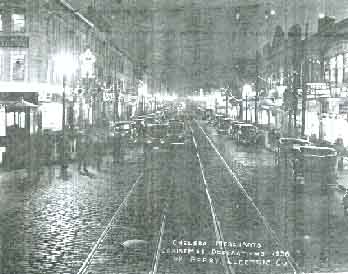
Broadway at Bellingham Square. Approx.1890
Chelsea prospered throughout the 19th century as transportation
connections between Chelsea and Boston improved. Steam powered
ferries and new street car lines made it possible for people to live
in Chelsea and work in Boston. Houses, stores and churches were built
along lower Broadway as the population grew. By 1900, Broadway was
the commercial center of a thriving city.
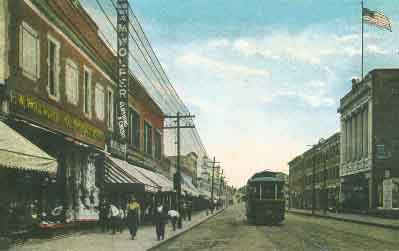
Broadway looking north toward Bellingham Square.
F.W. Woolworth and Wolpers Clothing on the left. Photo: Approx. 1900
taken at Third Street.
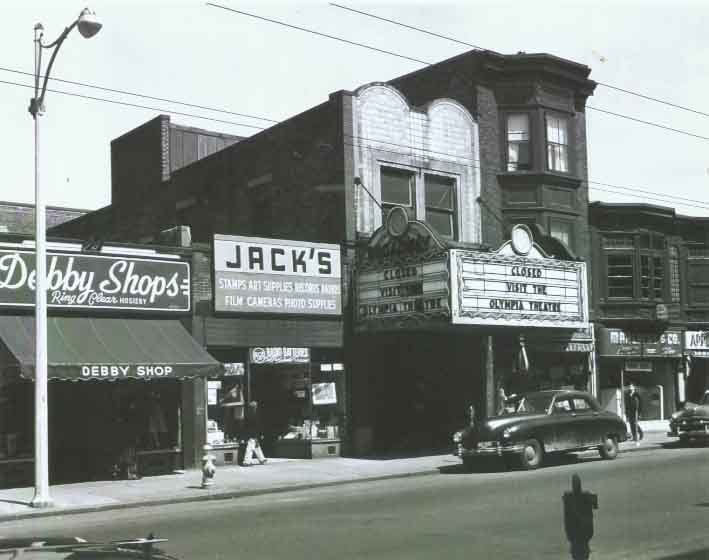
Broadway between Fourth St. and Bellingham Square
Broadway Theartre approx. 1950
The 1908 fire destroyed half of Chelsea, including all of the
buildings on Broadway above Chelsea Square. Rebuilding began
immediately with construction of new houses, schools and municipal
buildings. Four years after the fire, the upper part of Broadway had
been completely transformed. What had been a tree-shaded street of
stores and houses was now a street lined with large commercial
buildings. After the fire, Chelsea prospered, and business along
Broadway flourished. The street was filled with grocers, butchers and
dry goods stores. Vaudeville and movie theaters attracted crowds. On
weekends the sidewalks were so crowded many people had to walk in the street.
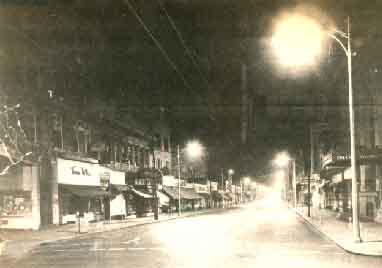
The photo on the left is from the early 1950’s. It was taken at
the corner of Congress Street and Broadway and shows the numerous
retail stores which used to occupy Broadway at the time. On the left
of the photo is Thom McAn, Fanny Farmer, Wolper’s Clothes, F. W.
Woolworth, W. T. Grant and Gorins. On the right is the former Chelsea
Savings Bank, which became the Atlantic bank and then the Boston
Five. Siegel’s Furniture and a Firestone dealer. At this point in
time, Broadway was a two way street with a Trackless Trolley.
From the 1930’s through 60’s Broadway gradually changed
again. With the introduction of the automobile, people moved to the
suburbs, and Broadway had to compete with shopping centers. The City
Revitalization Program, begun in 1977, recognized the importance of
Broadway in Chelsea’s future. From Bellingham Square to Chelsea
Square the street was enhanced with new sidewalks, benches, lights
and trees.
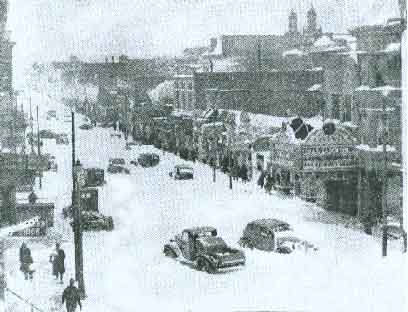
Stalled and abandoned cars on Broadway during a
major snowstorm on February 15, 1940.