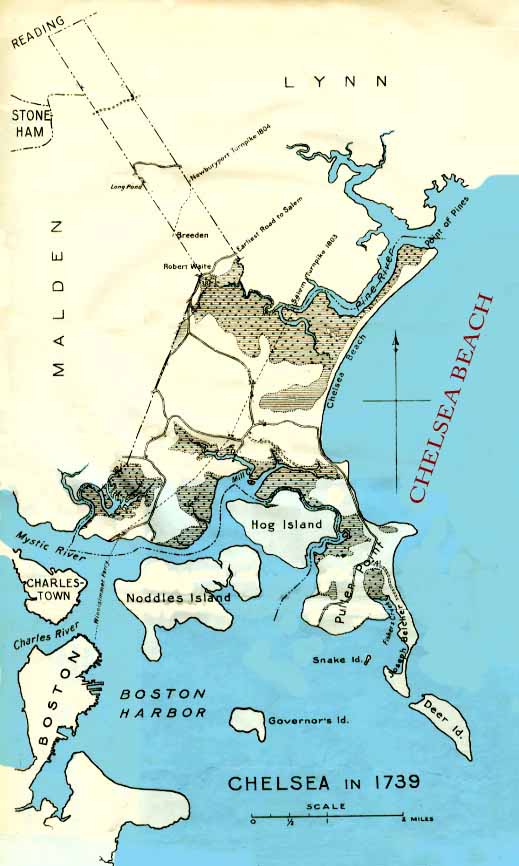
On January 10, 1739 Winnisimet, Rumney Marsh
and Pullen Point, known today as Chelsea, Revere and Winthrop were
set off from Boston and known by the name Chelsea. Included in this
was a 3 mile crescent shaped area of beautiful hard sand called
Chelsea Beach. Being only five miles from Boston it was discovered by
the influential and discriminating class and soon became the
playground and summer resort of the north
later to be known as Revere Beach.
The care of its beaches and marshes were of great importance to the
people of Chelsea. The preparation of the soil and marshes for the
cultivation of English grasses and salt hay was a slow and costly
process. They tried to protect them from storms which sometimes
covered acres with sand and pebbles. The removal of sand and stones
that were used for ballast made these storms more destructive. From
an early time in its history, Chelsea claimed exclusive rights to
Chelsea Beach and attempted to regulate the taking of sand, seaweed
and other items from the beach. In the1700’s numerous laws had to be
passed prohibiting the taking of stones, gravel and sand from the
beach, a practice that was being done by the cartload
On March 11, 1765 at a town meeting in Chelsea, it was voted to
appoint four persons to take care of the town’s beach in order to
prevent other town’s people from carrying off sand, clams, rockweed
or trash. Again on May 21, 1772, it was voted that their committee
shall have the same power, as given in 1765, to prosecute any and all
persons from outside of Chelsea that take and carry off from Chelsea
Beach any sand, clams, rockweed, rubbish or trash. On April 3, 1786
the town appointed a committee to inspect the beach. On April 2, 1792
the town voted that the inhabitants of other towns have no right to
carry anything off of Chelsea Beach. One month later on May 2, they
chose a committee to inquire into the property of Chelsea Beach.
April 6, 1795 the committee reported that, in their opinion, it was a
damage to the beach and town to remove any stones or ballast from the
beach. February 12, 1798, the selectmen of Chelsea petitioned the
General Court that an act may be passed preventing all persons,
except the residents of Chelsea, from taking any sand, gravel, stones
or manure from Chelsea Beach. On March 4, 1799 the town voted that
the beach is the property of the Town of Chelsea and that any person
not an inhabitant of Chelsea, who removed any manure of any kind from
said beach, shall be prosecuted by the committee. May 11, 1812 the
town voted to petition the General Court for power to regulate the
beach in the town.
Chelsea Beach later Crescent Beach then Revere Beach
On March 19, 1846, Rumney Marsh and Pullin Point (Revere and
Winthrop) were set off as North Chelsea. The selectmen of North
Chelsea then petitioned the General Court for control of the beach.
On April 14, 1855 the House of Representatives, Committee on
Mercantile Affairs and Insurance, to whom the Petition of the
Selectmen of the Town of North Chelsea was referred, authorized the
following bill:
Section 1. No person or persons shall carry away any sand, stones,
gravel or muck, from any beach in the town of North Chelsea without
permission first obtained from the selectmen of said town of North
Chelsea, or from some person or persons duly authorized by the
selectmen of said town to grant such pernmission.
Section 2. Any person who shall offend against any of the provisions
of this act shall forfeit and pay for each offense a sum not
exceeding twenty dollars to be recovered by complaint or indictment
in any court of competent jurisdiction, one-half for the use of the
complaintant, the other half for the use of siad town of North Chelsea.
Section 3. All acts and parts of acts inconsistant with the
provisions of this act are hereby replaced.
Section 4. This act shall take effect from and after its passage.
In 1834, two hotels were built on the beach side to cater to the
elite, the Neptune and the Robinson Crusoe House. These were soon
followed by the Surfside Hotel and other less important hotels.
Steamboats soon brought pleasure seekers from Boston, Nahant, Lynn
and other areas. The majority cf visitors came by the narrow gauge
Boston, Revere Beach and Lynn railway. Three feet wide and eight and
one half miles long, the Boston, Revere Beach and Lynn Railroad was
built in 1875 from the East Boston ferry pier to the nearby
industrial city of Lynn. Midway along the route was the City of
Revere. The fare from Boston to the beach was 5 cents. The wholle
beach was soon becoming occupied with shacks and shanties of the
cheapeast type. Bath houses were being thrown up along the very
water’s edge. In 1871 when North Chelsea changed its name to Revere,
the name Chelsea Beach was referred to as Crescent Beach. In 1893 the
Metropolitan Parks Commission was established with the goal of
protecting scenic areas and making them available for public use. In
January of 1893, landscape architect Charles Eliot submitted a
25-page report to the newly formed commission. The report detailed
the creation of such public open spaces as may best promote health
and happiness of the inhabitants of the metropolitan district.
Included in Elliot’s master plan was the design of a public beach
from Withrop’s Great Head to Revere Point of Pines. Under that
design, Eliot called for a thorough reformation of Crescent Beach,
which he saw as a fine beach but one close to ruin because of lack of
attention. Soon to be called Revere Beach, the first step was to
removed the numerous structures situated on stilts that stood on the
water side of the beach. Next would be to move the narrow guage
railroad tracks on Railroad Avenue, now Revere Beach Boulevard,
further west. In 1894 the state legislature appropriated $500,000 for
Revere Beach and in 1895 another $500,000 was appropriated. In late
1895 the MPC then exercised its right of eminent domain to seize
ownership of three miles of the beach, clearing away the buildings
and restoring its scenic beauty. The railroad tracks were relocated
to where the MBTA Blue Line tracks now lay. On Sunday, July 12, 1896
the new Revere Beach was opened as America’s first public beach with
over 45,000 people showing up to bath in the warm sun.
The beach began to deteriorate in the 1950’s. By the early 1970’s it
had become a strip of honky tonk bars and abandoned buildings. The
Great Blizzard of 1978 proved to be the final death knell for the old
Revere Beach, as many of the remaining businesses, amusements,
pavilions, sidewalks, and much of the seawall were destroyed.
In the 1980’s the beach was the focus of a major revitalization
effort by the Metropolitan District Commission and the City of
Revere. It was officially reopened in May of 1992.It now boasts high
rise housing units, a resanded beach, restored pavilions, and a
renovated boulevard.
