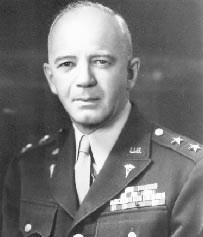
Raymond Whitcomb Bliss was born in Chelsea, Massachusetts,
on 17 May 1888. He graduated from Tufts College, Medford,
Massachusetts, in 1910 with a Doctor of Medicine degree and was
commissioned a first lieutenant in the Medical Reserve Corps on 19
September 1911. In June 1913, he graduated from the Army Medical
College, Washington, DC. In September 1914, he went to Fort Apache,
Arizona, and then to Schofield Barracks, Hawaii, in May 1915. Two
years later, in August 1917, he returned to the States and assigned
to the command of the base hospital, Camp Wheeler, Georgia. In
October 1918, he moved to the position of Commander, General
Hospital No. 35 at West Baden, Indiana, and in May 1919, became
Commander, General Hospital No. 20, Whipple Barracks, Arizona.
In February 1920, Bliss received orders to Fitzsimons
General Hospital, Denver, Colorado. From August 1920 to September
1921, Bliss took a special surgery course at the Harvard Medical
School, Cambridge, Massachusetts, and then remained in Boston for
study in the surgical clinics and further instruction at Harvard
College. In October 1921, Bliss became executive officer of the
hospital subdivision of the Veterans’ Bureau in Washington, DC. In
January 1923, he transferred to Walter Reed General Hospital,
Washington, DC. In November 1924, Bliss went to Camp Stephen D.
Little, Arizona, as Camp Surgeon and Medical Supply Officer. Bliss
went to Sternberg General Hospital, Manila, Philippine Islands, in
April 1929, and became Assistant Chief of Surgical Service there in
July 1930. Upon his return to the United States in May 1931, Bliss
was assigned to duty at Fort Sam Houston, Texas, where he became
Assistant Chief of the Surgical Service in July 1931, and Chief of
Surgical Service in July 1936. In November 1936, Bliss went to
William Beaumont General Hospital, El Paso, Texas, as Chief of
Surgical Service. In September 1940, Bliss went to London as a
Military Observer. Upon his return in January 1941, he was assigned
to Fort Sill, Oklahoma, as commanding officer of the post hospital.
In February 1942, he became Surgeon, Eastern Defense Command and
First Army, Governors Island, NY. In June 1943, he became Chief of
Operations Service, Surgeon General’s Office, Washington, DC. “It
was during this period that General Bliss demonstrated his
remarkable ability to plan medical support on every continent for all
types of combat operations. He was largely responsible for actuating
several unique operational developments featuring the widespread use
of air evacuation in the combat zones, from oversea areas of
operations to the United States, and the distribution of patients
within the United States; the system or regional hospitalization and
the establishment of specialized general hospitals to meet the needs
of combat casualties; and the establishment of convalescent hospitals
as definitive treatment centers for certain types of neuropsychiatric
patients, and as final treatment centers for large numbers of sick
and wounded. His masterful planning assured adequate medical support
at the time and place needed, and the successes achieved by military
medicine during World War II attest to the soundness of the detailed
medical plans.” During the war, Bliss made extensive trips to
Pacific Ocean Areas; and later he was named an Observer at the Atom
Bomb Test at Bikini. In August 1944, he became Assistant Surgeon
General, Surgeon General’s Office, Washington, DC, and on 1 June
1947, Bliss became the Surgeon General of the Army for a four-year
period. As the Surgeon General, General Bliss was not content to rest
on past accomplishments, and he launched a vigorous campaign to
institute many reforms within the Army Medical Service. His efforts
focused primarily on preparedness for future conflicts, and he was
determined to offer the military physician ample opportunities to
increase his professional competence and to undertake medical
research that was essential to his professional growth and that of
the Army Medical Service. Army hospitals became training institutions
for the first time in history by offering residency training programs
to the career officer. Health education and preventive medical
programs were expanded and given new vitality. Laboratories were
expanded and satisfied Bliss’s great concern for facilities capable
of conducting research and study of the pathology of diseases with
emphasis on both clinical and preventive medicine. He led the way in
the vigorous investigation of any suggestion which had promise of
increased protection or better therapy from the effects of nuclear
radiation. Basic to all these developments was his firm belief that
the best medical defense that could be offered in future wars was an
alert corps of highly competent and progressive physicians who,
together with the other professions allied to medicine, would be
capable of meeting any new situation. General Bliss, in rebuilding
the Army Medical Department on a sound professional basis, solicited
increased utilization of professional civilian consultants to
integrate the work of civilian medicine in military medical planning
and operations. He nurtured the system of visiting civilian
consultants with an increased role for these specialists in the
teaching programs of Army hospitals. The soundness of his reforms
finds evidence in the high quality of medical service provided by the
Army during the war in Korea. The low death rate, the high recovery
rate, and the high morale of the casualties demonstrate the
effectiveness of the progressive and specialized training programs
initiated by General Bliss.