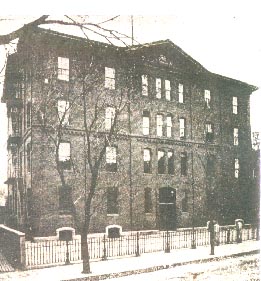
It was fast approaching fifty years since Abbot Bassett graduated
from the Old Williams School on July 23, 1861. Abbot a member of the
first graduating class of the Williams School, could not remember the
school building ever being called the Williams School. It was always
referred to as the “Boys’ Grammer School” and Abbot’s
diploma stated the same. There was only one other grammer school in
the city at that time, the “Girls’ Grammar School,” which
later became the Shurtleff School.
When the scheme for naming the schools was approved, the names of the
tenant farmers of the Bellingham farms were chosen. Henry Howell
Williams, for whom the Williams School was named, rented the whole of
Noddle’s Island for farming purposes. This was the farm that was
raided and burned in the Battle of Chelsea Creek in May of 1775. In
addition to Noddle’s Island, Williams also conducted a dairy and
poultry farm in Winnisimmet Village, which he called Howell Place. In
1800, Williams moved to Winnisimmet Village and took up residence in
the mansion house erected by Samuel Watts, the original owner. The
mansion was on the slope of a hill on the northerly side of Beacon
Street between Pembroke and Tremont Street. This hill ran down to a
beautiful sandy beach. On December 26, 1802, Henry Williams passed
away. Williams’ son Thomas, managed the Noddle Island farm until the
East Boston Improvement Company took over the land ending a seventy
year claim by the Williams family.
The Williams School opened in January 1861 and graduated it’s first
class the following July. Abbot said they were a very happy bunch of
boys when they left the “red ark” on Maverick Street and
entered the “palatial” edifice on Walnut Street where
everything was clean and new and up to date. The big desks with the
lifting covers were great for hiding actions from the teacher such as
biting an apple or to crack peanuts. Mr. John P. Payson was the
Master and as Abbot Bassett stated: “Mr. Payson was a master of
the old-school type in the matter of discipline, and that means that
he knew no other rule than of the active rattan.” The students
thought him unjust and unfair in many instances and with time never
changed their opinion. Abbot admitted the man had many admirable
qualities and as a teacher was remarkably talented. Master Payson
tried to encourage the formation of a debating club after school, but
the boys were anxious to get home to dinner and did not relish public
speaking. Payson next tried “bean bags” but this was
considered a girls’ game. Finally, Payson began to teach the boys to
sing, something only the girls were taught. This was the beginning of
the idea that boys be taught singing in the Chelsea schools.
In the words of Abbot Bassett: “I don’t believe it ever fell to
the lot of many boys to have a more pathetic graduation than that
which we had to go through. On Sunday July 21, 1861 the very
disastrous battle of Bull Run occurred. The first big battle of the
Civil War was a decided defeat for the Union Army. Chelsea Company H
First Massachusetts Regiment was engaged in it and lost several men.
The company was the first to go from this city and in it’s ranks were
sons, brothers, and husbands. Two days later on the twenty-third of
July, and when the incomplete returns of the dead and wounded had
been received, we gathered for our graduation exercises. Every person
was in a state of suspense and dread fearing later news would bring
further disaster. It should have been a time of rejoicing for the
students, but it was a most mournful occasion.”
The foregoing was adapted from a story by Abbot Bassett on the
fiftieth anniversary of the first graduating class of the Old
Williams School in 1861, of which he was a member. Abbot Bassett was
the publisher of the Chelsea Public, a weekly newspaper and served as
a member of the Chelsea School Board in the 1870’s. Mr. Bassett was
prominent in the League of American Wheelmen, an organization of
bicycle enthusiasts in the late nineteenth century and served as its
secretary for a number of years.