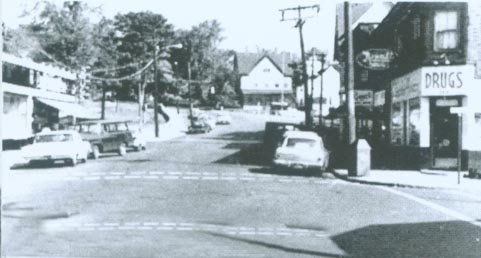
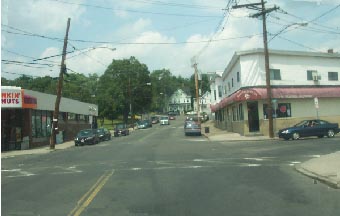
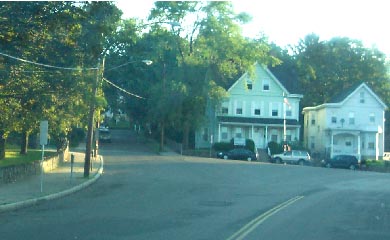
Prattville of today is the part of Chelsea
that lies north of the Revere Beach Parkway.
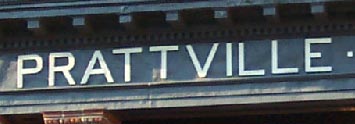
The first owner of Prattville was Sir Henry Vane when on January 8,
1637, the town of Boston allotted to Sir Henry Vane a tract of 200
acres of land in the part of Rumney Marsh now known as Prattville.
Shortly after receiving the grant of land Sir Henry Vane sold the
land to a Mr. William Brampton. In 1639 Brampton sold the land to a
Nicolas Parker of Boston who was a merchant. Nicholas Parker then
sold 160 acres to George Burden of Boston and on February 12, 1651
sold the same to Aaron Way and William Ireland for 230 pounds. From
the ownership of Way and Ireland this land came into the possesion of
the Pratt family in 1695 for 830 pounds.
The original deed of the Pratt farm describes the estate as
beginning at the northeast corner of the Carter Farm, a point near
the junction of County Road and Washington Avenue today, running
westerly to the Malden, now Everett line; thence northerly along that
line, but going westerly at same point so as to include thirty-five
acres in Everett before reaching the Revere line, continuing to the
Newgate Farm, then easterly across the top of Fenno Hill to the
marsh, then southeasterly across it to Chelsea Creek; thence westerly
by the Creek, at the foot of Powderhorn Hill, to the beginning.
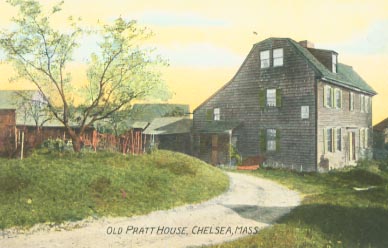
The old Pratt House was at 481 Washington Avenue
near Lambert Ave. Torn down in 1953.
The boundaries include besides the Prattville of today, a part of the
Fenno Farm and the Cheever Farm in Revere, Revere Highlands and
Woodlawn Cemetery. They also include the site of ” The Battle of
Chelsea Creek” (the first Naval Battle of the Revolution) ; the
site of the first Tide Water Mill, and Sagamore Hill now called Mt.
Washington, where the present Whidden Hospital is located.
Besides this property the Pratt estate included forty acres in Malden
near ” Black Ann’s Corner ” referred to as the wood lots,
marsh land, now part of the Lynn marshes, and a large tract of land
at Pullen Point, now Winthrop, which included Point Shirley.
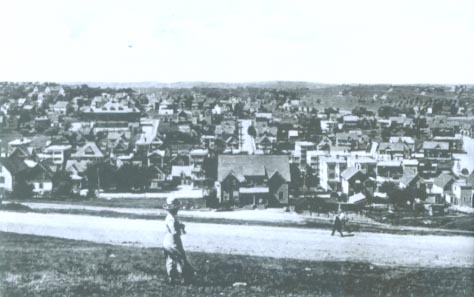
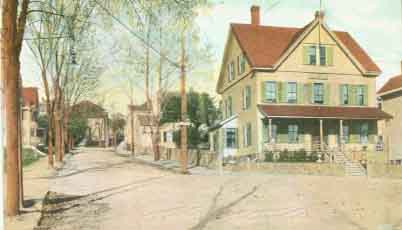
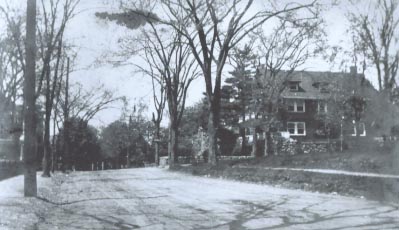
This 1905 photograph is of Prattville as seen
from the top of Powderhorn Hill. On the left is Mt. Washington where
the Whidden Hospital stands today. The street in the center is
Lambert ave. The rear of the new Prattville School is seen with
Engleside Avenue on its right and a glimpse of Murray Street on its
left. The street on the far right is Garfield Ave., just recently constructed.
Prattville has an interesting and historical background. Few places
of its size can point to more historical first things than can this
little settlement. Samuel Maverick settled in Winnisimmet in 1624, at
the mouth of the Mystic River, two miles from Prattville. The area
was nearly isolated by the marshes that ran to the southern slopes of
Powderhom Hill, except for a narrow strip of land leading to what is
now Cary Square. Over a trail, which by necessity must have followed
closely what is now Washington Avenue, the Sagamore Indians would
pass to Maverick’s Trading Post to sell their furs. This mild and
friendly tribe inhabited Prattville when the English first arrived,
and used it for hunting and fishing. As late as the early 20th
century it was still a common thing to find Indian mounds and Indian
relics in parts of Prattville. It is impossible to locate exactly the
haunts of the Indians. Their rude cultivation of the soil was
subordinated to hunting and fishing.
As early as 1641 and until 1855 Mount Washington in Chelsea and
Everett was known as Sagamore Hill; a name as it implies that on, or
near it, the Indians of that name had one of their villages. Many
years ago, Isaac Pratt, then in his eighty-third year, said he
thought their principal abode was not far from his house in the
pleasant valley which slopes gently to the sun from Woodlawn to the
foot of Mount Washington, or Sagamore Hill. He had found the remains
of an old fort near the brook, beside which he had dug up clam
shells, mortars, pestles, axes and other Indian implements. Besides
this fort, there were marks of two others: one on the top of Fenno
Hill, and the other on Powderhorn Hill.
As has been the history of the Indian, he was no match physically or
mentally for the English. The traditional story of Powderhorn Hill
being exchanged for a horn of powder is an illustration as to their
weakness as traders. Partial civilization brought smallpox and
consumption, and by 1700 the Sagamore Indians had practically passed
out of existence. The Sagamores willingly traded away their lands,
but they never took kindly to being excluded from them afterwards.
Little trouble was experienced, however, during the life of John and
James Sagamore, but upon their deaths the succession passed to their
brother George. Sagamore George made trouble for the landowners in
Rumney Marsh and Prattville. For more than ten years, sometimes by
suit in the inferior courts, and at other times by petitions to the
General Court, he claimed the lands were unjustly taken from him.
Finally, on May 19, 1669 the General Court dropped all his claims.
In 1641 the Country Road was built from the ferry in Winnisimmet
through Prattville to Salem. This road did much to help develop
Prattville. This substantial and prosperous community has developed
gradually in the past few hundred years on what, in1695, was the farm
of Thomas Pratt.
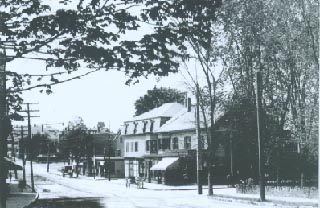
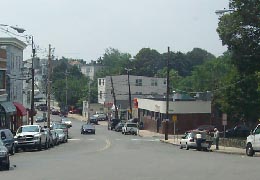
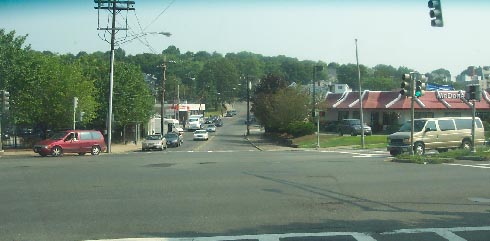
Today, there is the Old Prattville School, which is now condiminiums.
Two pizza places, Dunkin Donuts, McDonalds, and a number of small
markets and other stores and shops. It has a Catholic Church, a
Protestant Church, its own Fire Station, Washington Park, and several
thousand inhabitants.