In 1918-19, a terrible outbreak of influenza occurred, which
traversed the globe and killed between 50 and 100 million people
worldwide. The Great Influenza of 1918 or Great Pandemic began its
extremely lethal Second Wave from the Port of Boston.
The United States mobilized for World War I during 1917. Encampments
were quickly set up throughout the country, supported by a limited
number of hospitals, doctors, and nurses. Fighting men from east and
west, north and south, farm and city with varying immunity to
diseases were placed together in tight quarters in these training
camps. A wave of influenza had occurred in early 1918, which became
more virulent on a trip from the United States to France and then
back to the United States.
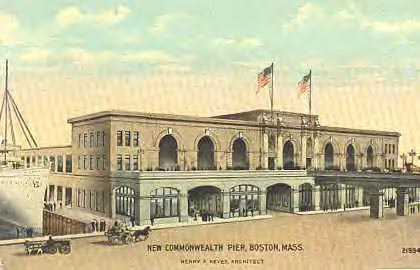
It started on August 27th 1918 at Commonwealth Pier in Boston,
Massachusetts. Sailors fell ill and were sent to the local Chelsea
Naval Hospital at Chelsea, Massachusetts. At about the same time,
ships departed for Philadelphia and New Orleans, transmitting the
deadly virus. The flu also quickly spread to nearby Camp Devens in
central Massachusetts, devastating the population of soldiers there.
At the height of the epidemic at Devens, about 100 soldiers were
dying per day.
In September 1918, the constant transfer of troops spread the deadly
disease throughout the United States, and then to many parts of the
globe. The civilian population was also quickly infected with the flu
because of large public mobilization parades, and then later victory parades.
Influenza epidemics had occurred before in world history, but this
swarm was more deadly than any other until then. The virus attacked
the lungs, with the human body’s own immune system destroying them in
a large percent of deaths. The impact of this pandemic was
unprecedented. In some military hospitals, toe tags and sheets were
placed with flu patients, as to make the process of re-filling the
beds more efficient for the next.
In greater Boston, about 1,000 people died during the pandemic. In
October 1918 alone, about 195,000 Americans died of influenza and its
complications. Tens of millions were struck down worldwide. Great
lessons were learned by public health officials-from not mixing
diverse populations to effective quarantine procedures-which have
greatly reduced the likelihood of a flu outbreak of this scale ever
again. Due to the quick spreading of the disease, many family members
would be found dead in their homes, sometimes with one sick child.
During the last days of August 1918, Navy physician J.J. Keegan,
stationed at the Chelsea Naval Hospital overlooking the waters of
Boston Bay, began to hear rumors of an unusual epidemic taking form
just across the bay at Commonwealth Pier. Keegan had expected a slow
August, stationed as he was far from the European battlefields of the
Great War. He had expected to find himself treating the occasional
sunburn or sour stomach as thousands of inductees–strapping young
men in the prime of life–passed through Boston en route to taking on
the Germans across the sea. But as news spread about an illness
sweeping through the large, noisy sailors’ barracks known as the
Receiving Ship, Keegan considered how to fight a silent enemy just
making its presence felt on US shores.
Little did Keegan know that the influenza he was seeing was
actually making its second appearance in the US. It had likely
originated at Fort Riley, Kansas, the previous spring and accompanied
unknowing troops across the Atlantic.
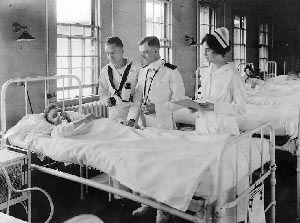
Now, the sailors filling the wards of Chelsea Naval Hospital quickly
overwhelmed the resources of medical professionals. The men Keegan
saw were suffering from no common flu–a nuisance ailment resulting
in sniffles, aches, a low fever, and a few days of bed rest. Rather,
the sailors coming into Keegan’s wards, many displaying a bluish
complexion with purple blisters, had been leveled by hoarse, hacking
breaths, barely supplying enough oxygen to keep them alive. As
confounded as doctors were about this ailment, they were certain of
one fact–this was no ordinary flu, and the number of its victims was
growing. Within just two weeks of its first appearance, two thousand
officers and men of the First Naval District had contracted influenza.
Ward scene at Chelsea Naval Hospital
June 1919
As bracing as these numbers were, more shocking to medical
professionals was what was found within the bodies of the dead: lungs
soaked with a bloody, foamy fluid that seeped out from beneath the
physician’s scalpel. What the fluid contained, what caused it to
drown the lungs, remained a perplexing mystery.
City officials in Boston were caught off guard when three
civilians dropped dead of influenza in early September. The epidemic
had now moved beyond the confines of the military and into the
general population. A “Win The War for Freedom” parade that
marched through the streets of Boston featured 4000 men, including
1000 sailors from Commonwealth Pier and 200 civilian Navy and
shipyard workers. This rousing display of patriotism did little to
end the war, and much to spread the deadly flu. Doctor John Hancock
of the Massachusetts Department of Health, sensing that perhaps the
genie was already out of the bottle, issued a statement warning that
“unless precautions are taken the disease in all probability
will spread to the civilian population of the city.”
For young Dr. Keegan, these were deeply troubling days.
Not only was he forced to stand helpless as legions died before his
eyes, he had to live with the knowledge that he was exposing himself
to their fate just by remaining within their airspace. Additionally,
Keegan and his colleagues began to question some of the assumptions
they had made about the science of infectious disease.

Theirs was the age of modern medicine; an age when scientists at last
had a grasp of how disease was caused and transmitted, and more
importantly, how it might be prevented and cured. Keegan and his
colleagues now found themselves chagrined, yet exhilarated, by the
challenge before them. As they dove into research and
experimentation, the flu continued to cut a deadly path along the
Atlantic seaboard. Reports poured in of cases appearing at naval
bases from Rhode Island to Florida. As September 1918 drew to a
close, Boston had lost more than 1000 citizens to the silent,
relentless killer. The deadly influenza now posed a threat to the
entire nation, and the world at large.
Chelsea Naval Hospital Laboratory
in June of 1919
A treatment was soon developed and used successfully in a long
series of cases at the naval hospital at Chelsea, outside Boston, and
first hand information based on interviews with the physicians who
originated and used the method was later brought to the medical
commission by Dr. Herman N. Bundesen, who was sent east by Health
Commissioner John Dill Robertson.
The treatment consisted of the injection of a serum extracted from
the blood of persons who have recovered from the influenza-pneumonia.
The onset of illness for those battling the flu of 1918 was quite
sudden. In a matter of mere hours, a person could go from strapping
good health to being so enfeebled they could not walk. Victims
complained of general weakness and severe aches in their muscles,
backs, joints, and heads. Often enduring fevers that could reach 105
degrees, the sick fell prey to wild bouts of delirium. Innocent
objects–pieces of furniture, wallpaper, lamps–would adopt wicked
manifestations in the minds of those consumed by fever. When the
fevers finally broke, many victims fortunate enough to have survived
now endured crushing post-influenzal depression.
Victims
This flu was a great leveler of men; it recognized neither social
order nor economic status. It struck with impunity among the rich and
famous, as well as the lowly and the meek. Among its more well-known
victims: Silent screen star Harold Lockwood, swimmer Harry Elionsky,
“Admiral Dot,” one of PT Barnum’s first midgets, Irmy Cody
Garlow, the daughter of Buffalo Bill Cody, General John Pershing,
Franklin Roosevelt, actress Mary Pickford, and President Woodrow Wilson.
The following individuals were recognized for
their efforts in developing the influenza serum at the Chelsea Naval
Hospital in 1919.
MCGUIRE, LEE W.
Lieutenant Commander, U.S. Navy
U.S. Naval Hospital, Chelsea, MA
Date of Action: 1918 – 1919
Citation:
The Navy Cross is presented to Lee W. McGuire, Lieutenant Commander,
U.S. Navy, for distinguished service in the line of his profession
while serving at the U. S. Naval Hospital, Chelsea, Mass., in
developing a convalescent influenza-pneumonia serum, which has proved
of very great value in reducing mortality from 38 to 4 per cent, and
for general service at the hospital.
BROOKE, ELSIE
Chief Nurse, US Navy.
U.S. Naval Hospital, Chelsea, MA
Date of Action: 1918 – 1919
While Serving as Chief Nurse at the US Naval Hospital, Chelsea,
Mass., she exhibited highly commendable devotion to duty in attending
to the sick, particularly during the influenza epidemic in the fall
of 1918.
REDDEN, WILLIAM R.
Lieutenant (MC), U.S. Navy
U.S. Naval Hospital, Chelsea, MA
Date of Action: 1918 – 1919
Citation:
The Navy Cross is presented to William R. Redden, Lieutenant (MC),
U.S. Navy, for distinguished service in the line of his profession
while serving at the U.S. Naval Hospital, Chelsea, Mass., in
developing a convalescent influenza-pneumonia serum, which has proven
of very great value in reducing mortality from 38 to 4 per cent, and
for general service at the hospital.