It
is five o’clock April 12, 1908. We enter a city beleagured and
replete with human suffering. The fire that began at ten o’clock in
the morning is still raging. Thirty fire departments and three
hundred men have joined forces with Chelsea firefighters to put this
blaze in check.
The
strength of the fire was so intense that residents of Portland,
Maine (a city 120 miles away) could see its glow. John M. Reynolds in
his article, Chelsea On Fire, published in the
April 1968 edition of Yankee magazine,
notes: “The full effect of Chelsea’s agony became apparent when
darkness disclosed a mile long sheet of flame stretching along the
North Shore. As far away as Portland, Maine the glow was so bright
that many were led to believe York Beach (Maine) was the site of the fire.”
Amid
the confusion, three hundred Chelsea citizens were injured. The
local court, spared from the blaze, served as a hospital with doctors
and nurses in attendance. Firefighters pressed bandages to their eyes
and found themselves still gasping from the contact with the smoke.
Women, with no place to go and uncertain of the fate of their friends
and family, cried in the empty courtrooms. We can only imagine the
horror of losing all that you have and wondering whether or not your
children were alive and well. We can only imagine the feelings of
utter destitution that engulfed these Chelsea citizens. Walter Pratt
tells us: “In the court room were, homeless women huddled in
gray despairing heaps on the hard benches. At the back of the room,
rows of rubbercoated men leaned back on their hard benches, their
inflamed eyes completely hidden by sqaures of soft absorbent cotton
soaked with ointments, which showed up with startling effect against
their blackened faces.
By
eight o’clock, the fire had begun to subside. It had taken 40
million gallons of water to put the blaze in check. This was a
tremendous amount of water when you consider, that on an average day,
Chelsea only used 3 million gallons.
Thousands of refugees aimlessly
wandered the streets. The high school on Crescent Avenue opened its
door to some, but it was forced to refuse others. There just wasn’t
enough room. Some refugees sought shelter in adjoining towns and
cities. The less fortunate and a good percentage of the homeless were
forced to erect tents provided by the state. Still others laid their
weary bones on park benches covered by overcoats or blankets.
By
10:30 p.m., martial law was proclaimed in the city of Chelsea.
Movement in and out of the city was highly regulated and restricted.
Trains, trolley
cars and ferries were forbiddin to run. Electrical power was cut off
to prevent electrocution from the fallen wires.
With the
martial law came twelve hundred troops to enforce the law, to prevent
looting and assist the homeless. These troops often spent eight hours
at a stretch guarding public
and private
property from thieves. For with the destruction came the junk thieves
hoping to make an extra penny out of others’ misfortune. Police Chief
Shannon had arrested some individuals with stolen valuables in their possession.
The
troops were also needed to unearth the dead from the ruins. Many
individuals presumedmissing
were often times exhumed from the smoldering rubble. In the April
25, 1908 edition of The Chelsea Gazette, we read of the search for
the dead.
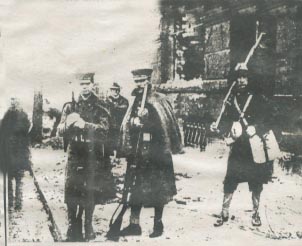
Cadets
and Coast Artillery troops guarding the Chelsea Savings Bank. These
were some of the 1200 troops sent into Chelsea to prevent vandalism
and looting and to enforce martial law.
“On
Sunday what was supposed to be the body of Benjamin F. Knowles,
was found in the cellar of his late residence, 34 Cottage Street. On
Monday the workman discovered another body in the cellar of the house
at 141 Central Avenue. It is believed to be that of William Morris, a
shoemaker, who lived at this place and who is missing. On Tuesday
another body was, found at the same address and was supposed to be
John Grillock, who has been missing
since the fire.”
April 13, 1908, Chelsea’s citizens rose on a blackened and
smoldering city. Hollowed
out buildings, burned-up mattresses,
dead
animals, the sick smell of smoke and monstrous destruction greeted
its inhabitants. In the face of such insurmountable obstacles, one
would expect the spirit of Chelsea’s citizens to falter. Falter, they didn’t.
Consumed
by overwhelming loss, the talk around town was “rebuild”.
Mayor John E. Beck, whose own home and newspaper were destroyed by
the fire, echoes these
feelings in the April 18, 1908 edition of The Chelsea Gazzette:
“The burnt district with its tottering walls, all that remain of
the homes of our citizens, is a most desolate scene, yet the courage
of our people remains undaunted, they look to the future with the
firm determination that from these ashes will rise a a new Chelsea.”
Beyond
the various relief
committees organized
and the outburst of support from local towns and cities, there was
the common occurrence of people taking their own initiative to help
others. Some made bushels of sandwich. Some fed the smoke-parched
firefighters coffee. And others plainly denied their own needs to
help others that they deemed were less fortunate. This is evidenced
in Fred W. Cheney’s article in the April 18, 1908 edition of The
Chelsea Gazette.
Fred
W. Cheney was a New
Hampshire insurance adjuster who visited Chelsea immediately after
the fire to file the claims of loss. He aptly wrote that you just
can’t understand the fire by reading how many sqaure miles and square
acres it took. It just won’t hit you that way. Fred says that it
begins to hit you when you stand amid the rubble and see an entire
city gone. It begins to hit you when “your eyes have softened
and your throat feels lumpy.”
Fred
was amazed at the self-sacrifice on the part of the Chelsea
population. Fred recounts the many times that
he aproached
people to get them to sign proof of loss so that they could collect
and he would meet resistance because it was more important for them
to help someone in greater need. He tells us: “I located one
lady who had a claim for loss, devoting her time to the distribution
of clothing, instead of hunting for the insurance company. I got her
proof all ready for signatures and then had to rely on a committeeman
to pass me by the sentries in order to reach her. She was helping a
little old man make up an outfit, and wouldn’t leave him for five
minutes for such a little matter as signing a proof of loss, until
she had procured a substitute for her work. This is only a typical instance.”
Chelsea
officials and the relief committees acknowledged the importance of
getting the homeless in homes. Sleeping in tents was extremely
unhealthy due to the cold weather and the lack of proper sanitation.
And this feeling of uprootedness that comes with sleeping in tents
made many leave Chelsea altogether. This was clearly recognized as a
danger by city officials. These citizens of 1908 were a good and
wholesome lot. It would be a great loss, indeed, for this city to
lose them.
To
rebuild 492 acres of destruction, Chelsea would need and would get
aid from local towns and cities. Many towns took up collections. Many
businesses donated materials for reconstruction and laborers would
have stricter codes to abide by. The junk dealers and rag shops were
given encouragement to leave the City as there were too many fires of
questionable origin. Many insurance companies refused to cover
businesses of this nature.
In
order to rebuild more effectively, Senator Alfred Hall of Suffolk
presented a bill on April 28, 1908 which would ask that five
competent men govern Chelsea for a certain period of time. These five
men were given the power of Mayor, Board of Alderman and School
Committee. They were to be called “The Commission.”
These
men would be chosen from Chelsea’s finest. They would be astute and
capable men. They would all be residents of Chelsea and most
important of all, they would have the interest of Chelsea at heart.
Rebuilding
would be painful, but out of this pain would emerge a new Chelsea.
Safer structures with stricter building codes would be erected. Rag
shops would slowly disappear. Storefronts would paint fresh signs and
open their doors for business. Saplings would replace the charred
remains of the ancient oak trees. And within its community the spirit
of survival and strength would allow Chelsea to move on.