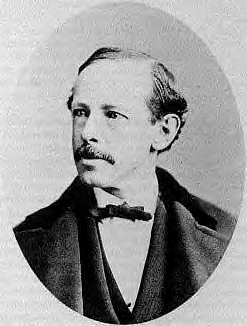
After attending Harvard Divinity School, in 1860, Reverend Alger
took a position as minister of the First Parish Unitarian Church of
Brewster on Cape Cod, but left for New York City rather suddenly,
ostensibly to pursue a career in writing. Church records uncovered
after Alger’s death indicate that he was quietly dismissed for having
sexual relations with several teenage boys in his parish. (As a
result, the New York City chapter of the North American Man/Boy Love
Association is named after him.)
Later in life, Alger wrote a poem, “Friar Anselmo’s Sin,”
which seems to be somewhat autobiographical. It begins:
Friar Anselmo (God’s grace may he win!)
Committed one sad day a deadly sin;
The poem goes on to recount the friar’s rendering of aid to a
wounded traveler, and ends with Anselmo’s redemption upon the
appearance of an angel who exhorts Anselmo to dedicate himself to service:
Thy guilty stains shall be washed white again,
By noble service done thy fellow-men.
The move to New York was a turning point in Alger’s career. He was
immediately drawn into the work of impoverished young bootblacks,
newspaper boys, and peddlers. It was this world, coupled with the
moral values Alger received at home, that formed the basis of the
first novel in his Ragged Dick series (1867). The book was an
immediate success, spurring a vast collection of sequels and similar
novels, including Luck and Pluck (1869) and Tattered Tom (1871), all
with the same theme: the rise from rags to riches. In fact, the theme
became synonymous with Alger, whose formula for success was based on
luck, pluck, and virtue.
Essentially, all of Alger’s novels are the same: a young boy
struggles through hard work to escape poverty. Critics, however, are
quick to point out that it is not the hard work itself that rescues
the boy from his fate, but rather some extraordinary act of bravery
or honesty, which brings him into contact with a wealthy elder
gentleman, who takes the boy in as a ward. The boy might return a
large sum of money that was lost or rescue someone from an overturned
carriage, bringing the boy – and his plight – to the attention of
some wealthy individual.
Despite his remarkable literary output, Alger never became rich
from his writing. He gave most of his money to homeless boys and in
some instances was actually conned from his earnings by the boys he
tried to help. Nevertheless, by the time he died in 1899, his books
could be found in virtually every home and library in America. His
books may no longer be as popular today as they once were, but the
moral messages they relayed were an important factor in the
development of the American dream in the 20th century.
At the time of his death, on July 18, 1899, Alger was living with
his sister Augusta in Natick, Massachusetts. She destroyed all of his
personal papers, hoping to avoid scandal in the rigid atmosphere of
the Victorian era. Today, however, his name appears on some compiled
lists of purported homosexuals.
Since 1947, the Horatio Alger Association has bestowed an annual
award on “outstanding individuals in our society who have
succeeded in the face of adversity” and scholarships “to
encourage young people to pursue their dreams with determination and perseverance”.