The Clay Pit was an arrant body of water that covered an area between
Locke Street and Gilhooly Road, Webster Avenue and the Revere Beach
Parkway. The Clay Pit created a hazard and a problem to life and
health for a number of years before being eliminated and the area put
to practical use. Many children drowned while attempting to swim the
water of the Clay Pit or by falling through the ice in the winter.
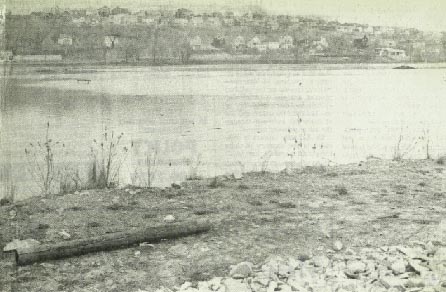
The Clay Pit – Cow Hill in Revere in the background
For many years the clay was dug from the pit and baked in a kiln
nearby to make bricks. Records have been found on the use of the Clay
Pit for brick making from as early as 1664. It was near here, on
Stockton Street, that John Low and his sons constructed a factory in
1877, and began producing the famous Low Tiles. With time the pit
grew in length and deepened, so that carts were needed to haul the
clay up to the kiln. As the clay was dug out through the years,
springs were being uncovered, causing the pit to gradually fill with
water. Due to the clay content in the pit the water became stagnant
creating nauseating odors.
The city treated the pit with chemicals in 1938, in an attempt to
eliminate the odors. The attempt seemed successful for a few years,
but in the late 1940s the stench returned. After considerable
discussions on how to cope with the problem the city agreed to have
the Clay Pit pumped dry.
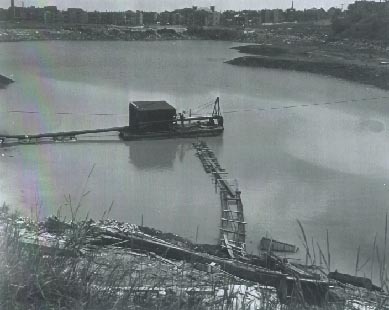
Two large pumps were borrowed from the Charlestown Navy Yard and
placed on barges in the middle of the Clay Pit. Suction hose lines
were stretched from the pumps to the Mill Stream near the parkway.
The water of the Clay Pit was pumped through these lines to the Mill
Stream, which flowed out to the Chelsea River. As the water lowered,
peirs were built to support the pumps and the barges were removed.
Covering soil was dumped on the mud to prevent any obnoxious fumes.
It was estimated that 123 million gallons of water were pumped into
the Mill Stream. Slag from the Griffin Wheel on Gerrish Avenue, heavy
fill from the Navy Yard and crushed rock from the M.D.C. sewer
project on Marginal Street, provided a solid bottom cover for the pit
and allowed for the building of two roads,
Draining of the Clay Pit before the construction
of the Bradlees Mall
one from Clark Avenue and one from Locke Street. The draining of the
Clay Pit was completed in march of 1953. The city now had a large
gaping hole to fill. Chelsea had ceased using the Williams Street
dump and was under contract to a Saugus facility for dumping. The
city fathers finally agreed to allow the dumping of municipal rubbish
mixed with sanitary fill to eliminate the huge waterhole once and for
all. Once the pit was filled, in 1960, all 37 acres were sold to two
businessmen at a bargain price of $50 per acre for a total of $1850.
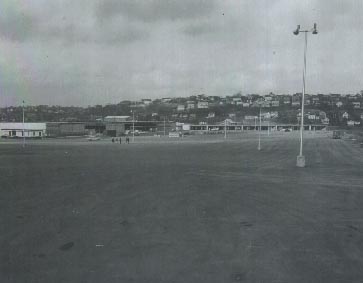
Building of the Parkway Plaza Shopping Center 1963
A large shopping center was erected on the site with top stores, Stop
and Shop, Bradlees and others. The Parkway Plaza Shopping Center was
opened on March 13, 1963. As the years passed, the Stop and Shop left
and the Bradless Department store closed. The Mall fell into
disrepair and most of the stores became vacant. In 2006 the mall was
completely refurbished, the parking lot was repaved and new stores
moved in, includung Home Depot. The buildings on this site have
greatly improved the conditions that existed at the Clay Pit. The
hazard to children no longer exists and neighbors enjoy the air in
and around their homes.