THE GULF OIL FIRE of JANUARY 3, 1969
January 3, 1969 shortly after ten o’clock in the morning, tank
vehicles were being loaded with gasoline at the loading rack of the
Gulf Oil Refinery on Eastern Ave, when an unusual accident occurred
that would have tremendous development.
Tank vehicles were loading in bays 5, 7, and 8. The driver of the
truck in bay #7 had just moved his 6000 gallon steel tank,
semi-trailer into the bay and connected the bonding wire, as required
before the pump could be actuated.
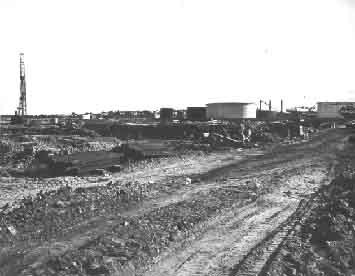
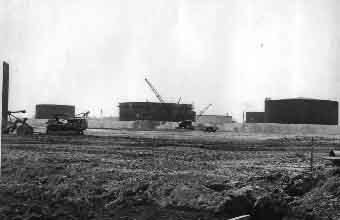
Construction of the Gulf Oil Tank Farm on
Eastern Avenue. – September 1948
He filled two compartments and was swinging the loading am to
fill another compartment when the elbow on that loading arm caught
the wire from the spring loaded valve on another loading arm causing
gasoline to flow from the second arm over his vehicle and to the
ground. In trying to disconnect the wire the driver’s clothing became
soaked with gasoline. The control room operator shut off the pump as
soon as he saw what was happening, but not before 127 gallons of
gasoline had been spilled. The gasoline ran down under an 8,000
gallon aluminum tank semi-trailer in bay #8 which had just filled two
compartmehts and was busy filling a third. Almost immediately fire
broke out from an unknown ignition source.
The driver of the truck in bay #8 was able to escape safely
but the driver of the truck in bay #7, Theodore Shirley, with the
gasoline soaked clothes became enveloped in flames. He hit the ground
and was immediately wrapped in a fire blanket by plant employees. He
was rushed to the hospital by ambulance but succumbed to his burns
two weeks later.
Despite the fire the driver of the truck in bay #5 was able to
jump in the cab of his truck and drive it out of the danger area. The
superintendent of Fire Alarm had just driven into the oil company
yard when the fire started and promptly radioed the alarm. Four
minutes later a second alarm was sounded.
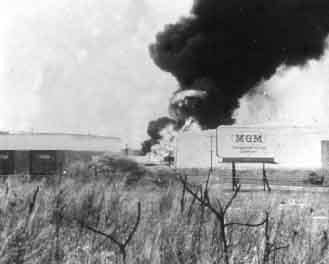
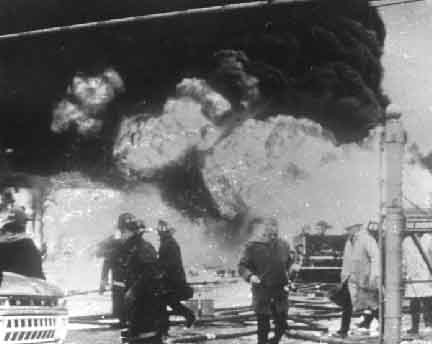
The first arriving apparatus had to contend with a frozen hydrant.
There was no protective extinguishing system in the racks. The fire
was fought with 1 1/2 inch mechanical foam lines from each piece of apparatus.
The two empty forward compartments numbers 1 and 2 melted and
the bulkhead between compartments 2 and 3
ruptured releasing 1,000 gallons of gasoline. By this time a third
alarm was sounded and the off duty shifts were called back.
The bulkhead between compartments 3 and 4 let go a couple of
minutes later releasing another 1100 gallons of gasoline.
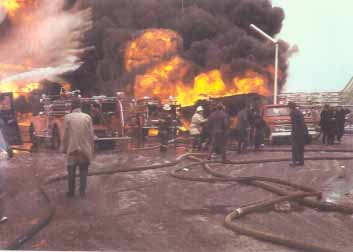
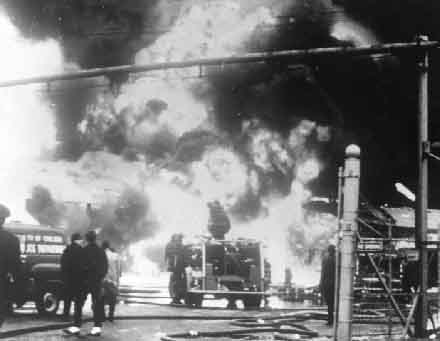
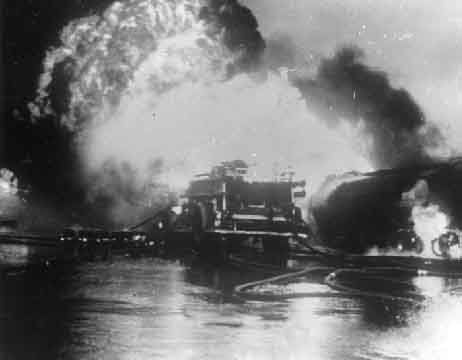
This was soon followed by the rear compartment, number 5,
rupturing violently from overpressure causing the trailer to travel
backward with the speed of a rocket The tractor remained at the
loading rack. The trailer travelled a distance of about 150 feet
coming to a stop beside Chelsea’s Engine 1 pump involving it in
flames. The pump burned to a total loss and four fire fighters were
seriously injured. The four injured local firemen were taken to
Chelsea Memorial Hospital, where they received medical attention,
after which three of them were released. Held for further treatment
was firefighter Robert Ostler of Engine One.
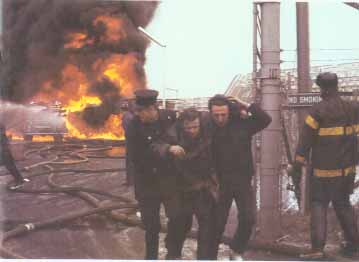
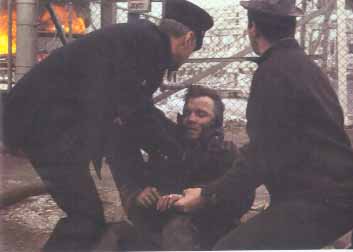
Shown in the photos above is Firefighter Robert Ostler being taken
from the scene after the exploding tanker crashed into Engine One.
Ostler was atop the apparatus when the collision occurred.
Released from the hospital were Captain Edward Roache of Engine Five,
James Keavney of Ladder One, and firefighter Joseph Capistran of
Engine One.
Truck driver Theordore Shirley, 64, of 32 Foster Pond Road, Andover
was badly burned from the hips down with third degree burns. He was
rushed to Massachusetts General Hospital and died two weeks later. A
second workman, Frank Rawson, 48, of 53 Stoughton Street, Stoughton,
Massachusetts was rushed to the Massachusetts General Hospital and
later released.
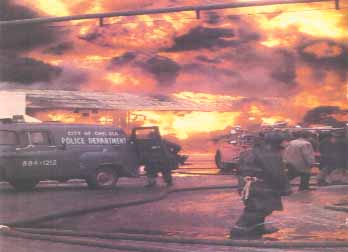
The 1 1/2 inch mechanical foam lines of the Chelsea Fire Department
were puny with a lack of volume and reach. Additionally, there was a
lack of operable firefighting equipment in the yard yet the
firefighters with great effort and in spite of battling the
unexpected, confined the fire with final extinguishment by a foam
truck from Logan Airport.
Fire apparatus from numerous surrounding communities responded to the
call for aid. Helping Chelsea firefighters in fighting the inferno
were crews from Revere, Everett, Malden, Boston, Saugus, Lynn,
Medford, Winthrop, Newton, Somerville, Quincy, Arlington, Lexington,
Watertown, Chelsea Naval Hospital, Logan Airport, Massachusetts Port
Authority, two Boston Fireboats and the Emergency Center from Somerville.
Damage to the Gulf Oil Terminal was estimated at $200,000. The damage
to Engine One was estimated at $35,000.