Shipbuilding in America began with the founding of the colonies.
Until steam engines and wooden hulls replaced sails and wood, all sea
going vessels were constructed of timber. Timber was a raw material
that existed in abundance in the new world. From the sixteenth
century, the timber situation in England and on the continent of
Europe had greatly deteriorated and by 1800 the shipbuilding nations
of Europe were suffering a timber famine. Due to the abundant supply
and cheaper costs of shipbuilding timber, American ships cost far
less to build than any European ship. Prior to the Revolutionary War,
Massachusetts’ led the rest of the country in the number of ships
built and aggregate tonnage. Most of these ships were merchant
vessels built for trade between the West Indies and North America or
for trade or sale to Europe.
In the post Revolutionary War days the economy of the
Massachusetts ship yards dropped considerably. The English markets
were denied to American ships along with harassment of coastal
traders by the British Navy. In 1786, the British applied their
navigation laws to the United States. This ended the British market
for American-built ships. In 1789, Congress passed a law that
required that American flag ships be built in the United States. In
1793 France closed another market for American ships by passing a
similar law. These events were followed by difficulties between
France and England and by the War of 1812.
During the period of 1830 to 1856 the American shipyards along the
eastern seaboard enjoyed a profitable increase in activity. This was
the era of the famed American clipper ships, the most beautiful ship
afloat. Built of oak and other hard woods, the clipper ship was
designed and built for speed instead of capacity. The lines of the
clipper evolved from a combination of features of the fast,
sharp-ended ships built for slave and blockade running and those of
the transatlantic packets and freighters.
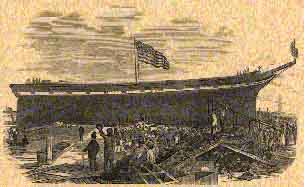
This splendid vessel was launched from the yard of John Taylor,
Chelsea, and is the largest that ever floated in our harbor (1851).
She is the property of Messrs. Bramhall & Howe, and is intended
for the cotton trade. She registers 1800 tons, is 192 feet keel, and
210 feet over all; depth of hold, 29 feet. After the launch she was
towed to the Navy Yard, Charlestown. The rigger, Mr. Joseph J.
McClennon, at Arch Wharf, commenced work on her Saturday morning with
a gang of nineteen men, and completely masted her in the short space
of six hours actual working time.
Launching of the ship George Washington at
Chelsea, Massachusetts 1851
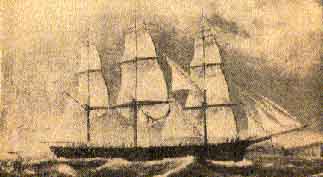
The clipper was a long, narrow vessel with concave
underwater lines and a long sharp bow flaring outward. The clipper
had three masts or more that were set with a great slake and with
square sails. These ships were designed to meet the needs of the
China tea trade in the 1840’s and the fast delivery of cargoes during
the California and Australia gold rushes.
S.S. FORMOSA Built in Chelsea
The S. S. Formosa, an early American trading
ship, was built in the local shipyard of John Taylor in 1868. The
Formosa was one of the most outstanding vessels in the era. It was
lost in the Alles Straits near Java in the South Pacific on January
3, 1880.
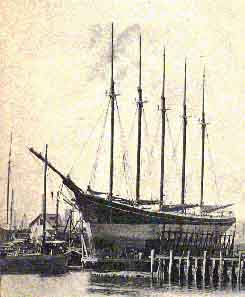
Schooner M. D. Cressy – Richard T. Green Company
– 208 Marginal Street.
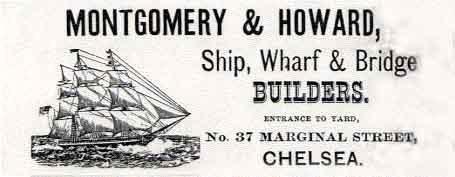
Numerous clipper ships were built in Chelsea shipyards that
stretched on the waterfront near Williams and Marginal Street. The
shipyards operated by shipbuilders: John Taylor, builder of
“Storm King” 1853, the “Nabob” 1854, the
“Malay” 1852, the “Aurora” 1853, the
“Derby” 1855, the “Lotus” 1852; Jotham Stetson,
builder of “Young Brander” 1853, “Neptune’s
Favorite” 1853, “Harry Bluff” 1855; Isaac Taylor,
builder of the “Matchless” 1853; Winde & Clinkard,
builders of “Daniel Webster” 1851, “Golden Gate”
1853, “William H. Atwood” 1852; from the yard of Rice &
Mitchell, the “Orpheus” 1856; from the yard of Paul Curtis,
the “Witchcraft” 1850; the yard of Dennison J. Lawlor, the
“Olata” 1853. These names, represents a few of the ships
built in Chelsea shipyards and their builders who helped write an
important chapter in the maritime history of our country. The sea
became a part of Chelsea life before the settling of the Village
section of the town. The shipyards in Chelsea were turning out
Sloops, Barks, and Brigantines before turning their abilities to
building Clippers. The durability, speed and low cost of wood sailing
vessels retarded the production of iron hull ships, introduced during
the Civil War period. The introduction of steel ships in the 1880’s
made wooden commercial ships obsolete and caused a decline in the
active shipyards.