On the evening of May 11, 1841, a meeting was held in
Guild’s Hall to establish an Episcopal Church in Chelsea. Until this
time, the people of Chelsea, had to travel to Malden or to Boston to
attend Episcopal Church service. Reverend John Woart, Rector of
Christ Church, Boston, presided over the meeting, closing with the
first ever Episcopal religious service to be held in Chelsea. At a
meeting held on September 7, 1841, the Parish was duly organized. The
name Mt. Zion Church was adopted for the new Parish. The Reverend
William S. Bartlett was appointed first Rector, officiating at
services held in Slade’s Hall each week until a church was built.
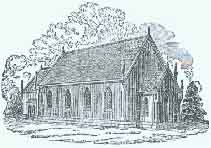
In March 1844, the name of the Parish was changed to St. Luke’s
Church, after a Parish church in Chelsea, England, of the same name.
The cornerstone was laid in August 1844 and the finished church
building was consecrated February 1845. The church, a simple, early
English, wooden structure, with a Gothic interior, was designed by
New York architect, Richard Upjohn. The church building was located
on or about 278 Broadway, between Third and Fourth Street.
The next few years was a struggle to exist for the small
Parish. In 1849, a misunderstanding was allowed to increase in
magnitude to a point of division in the Parish.
St. Lukes Church – Broadway – 1845
The dissidents withdrew from St. Luke’s Parish and on October 28,
1857, organized a second Episcopal Parish under the name of St.
Andrew’s. A new church building was designed by Arthur Gilman, the
architect of the Arlington Street Church in Boston, and constructed
by builder Jared Kibby. It was located on Hawthorn Street, corner of
Park Street and Central Avenue{Early Learning Center today}. The new
St. Andrew’s Church was dedicated on June 19, 1859. St. Andrew’s did
not survive beyond 1863 at which time it’s doors closed. The
parishioners of St. Andrew’s were invited to worship in St. Luke’s
Church. During 1864, the two congregations finally reunited as St.
Luke’s. On November 26, 1864, St. Luke’s bought the St. Andrew’s
Church building, moved in and rededicated the Church to St. Luke. The
church on Broadway was vacated. The Broadway building was destroyed
by fire in 1866 and in 1868, the land was sold. St. Luke’s began to
prosper and it’s membership started to grow.
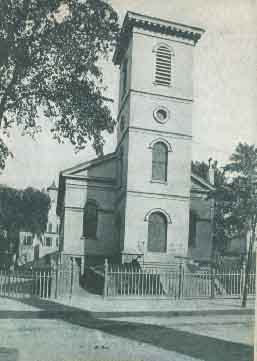
St. Andrews on Hawthorne St. – 1859
The question of need for a larger building and the structural
safety of the present building on Hawthorn Street, arose before the
turn of the century. In 1901, Judge Albert Bosson, deeded family land
on Washington Avenue, bordered by Spruce and Silk Street to St.
Luke’s Church. Judge Albert Bosson was born in Chelsea in 1853, of an
early Chelsea family. Judge Bosson graduated from Chelsea High
School, Brown University and Boston University Law School. Bosson was
Mayor of Chelsea 1890-1892; Judge of the Chelsea Court 1892 until his
death in1926 and also held various positions in St. Luke’s Church.
Besides giving the land, the Church is built on, Judge Bosson gave
the chancel in memory of his father; the stained glass window at the
rear of the chapel in memory of his mother; filled in the Silk Street
arches and gave a window in memory of his brother-in-law. The Judge’s
family gave a finely carved oak pulpit to his memory. There were many
more large contributors but at this time Judge Bosson’s was the largest.
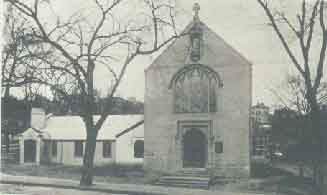
A new church was erected and dedicated on Washington Avenue in
1907, on the former Bosson land. A stone taken from the wall of the
centuries old Chelsea Old Church in Chelsea, England, was sent to St.
Luke’s, Chelsea for the dedication and is built into the new church
wall with an explanatory plaque. On the three hundredth anniversary
of the settling of Chelsea, {1924}, a stained glass window was
erected to the memory of Samuel Maverick. A donation was received
from the Archdeacon of Chelsea, England, toward the window. Samuel
Maverick was a member of the Episcopal Church
New St. Lukes Church – Washington Ave. – 1907
