Many of the soldiers returning from the Civil War were
broken, maimed and with health impaired by the effects of the war.
Many had no homes to return to, or were unable to take up the life
they had laid down many months before. Very few received a pension,
the amount allowed for total disability was eight dollars a month.
These veterans became destitute, having to rely on poorhouses and
various other charitable organizations.
The Grand Army of the Republic (G.A.R.), a Civil War
veterans organization, came into existence in 1866. The mission of
the GAR was to keep alive the fraternal feeling that had been formed
in camp, on the march, and in the line of battle and to help the
disabled comrades on the march of life. On June 17, 1875, the one
hundredth anniversary of the Battle of Bunker Hill, a conference was
held in Charlestown, for the purpose of establishing a Soldiers’
Home. Committees were formed throughout the GAR State Department to
solicit donations and run events to obtain funds for a Soldiers’
Home. In the meantime a number of members were incorporated as
Trustees of the Soldiers’ Home in Massachusetts. The next step was to
search for a location.
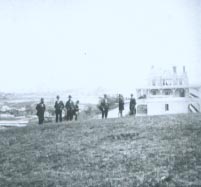
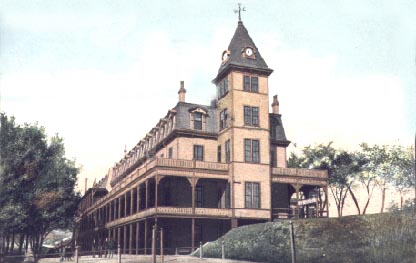
In 1873, while Chelsea was still the vacation resort of the
North Shore, a group of hotel men purchased a piece of land on
Powderhorn Hill and built an imposing building that became known as
the Highland Park Hotel. After a few years, due to immigration and
industrial growth, Chelsea lost it’s resort standing. The hotel
became a financial failure, was foreclosed and put up for sale.
This photo of the Highland Park Hotel is taken
from the top of Powderhorn Hill facing Revere.
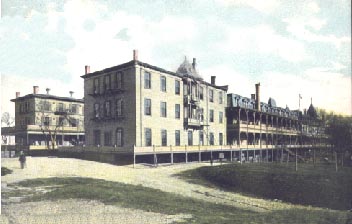
The Trustees of the Soldiers’ Home, after visiting many
places, decided to purchase the Highland Park Hotel. The estate
comprised the building, furnishings and four acres of land. The
original cost of the hotel was $110,000 but was purchased by the GAR
for $20,000.
The Home was dedicated June 8, 1882 and opened for admission June
25, 1882. At the dedication the Home was presented with two fitting
items: a bible, to be a guide in the journey of life to a better
land; and a flag, to inspire patriotism and love for the country
these members helped to save.
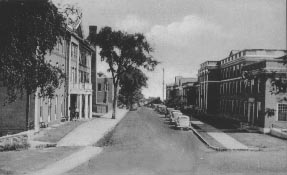
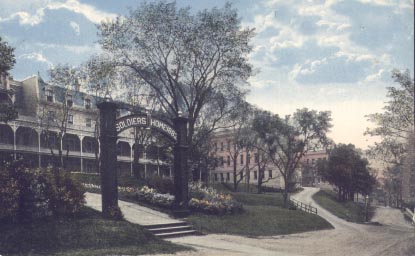
Soldiers’ Home – Crest ave. looking eastward –
photo 1950
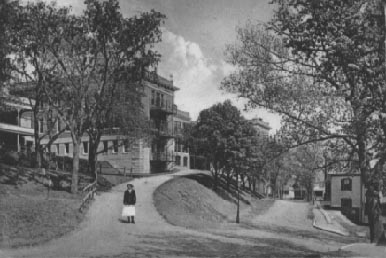
Rear Hillside Avenue Entrance – photo 1920
One year after opening, the Home was well established, free
from debt and with a balance of $30,000 in its treasury. Applications
for admission were beyond the capacity of the Home. It was apparent
more room was needed. In 1886 a hospital building was erected and
additional accommodations for fifty men were acquired. The following
year, found the Home crowded again and applicants being turned away.
The State legislature appropriated $50,000 to build an addition
making the Home capable of caring for Two hundred and eighty-eight
men. The GAR managed and supported the Home from it’s inception until
December 1934, when the State took over management.
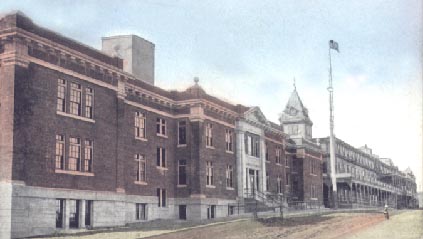
Soldiers’ Home Main Entrance – approx. 1910
Adams Hospital – Soldiers’ Home Chelsea – approx 1910
The State, in 1908, erected a separate, fire proofed hospital
building. It was named after the second vice president of trustees,
Capt. John G. B. Adams. He also served as president of trustees in
1883 and in 1884. – (Photo above).
In 1920, the laundry building was built of brick, the first step
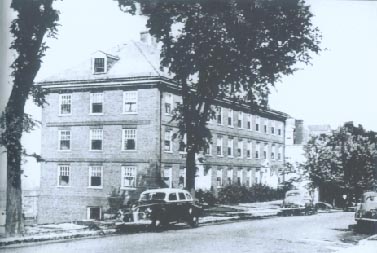
in the replacement of the old wooden buildings. The Nurses Quarters
(Keville House) was constructed in 1929. A members’ and employees’
dormitory was built in 1934 by the WPA. All wooden buildings were
eventually replaced by brick.
The Nurses Quarters (Keville House)
When the State took over the management of the Soldiers’ Home in
1934, Lawrence F. Quigley, six term Mayor of Chelsea, was appointed
first Commandant, by the Governor of Massachusetts. Lawrence Quigley
passed away in 1948 and was succeeded by his son John as Commandant.
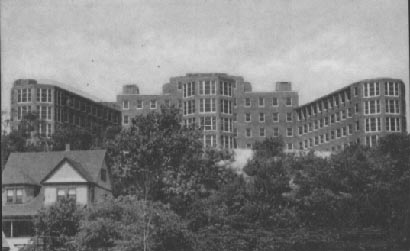
In 1950 a 300 bed hospital was built, opposite the Home, and named in
memory of Lawrence F. Quigley. The Home originally established by and
for veterans of the Civil War, later opened it’s doors to veterans of
all wars.
Quigley Memorial Hospital – Powderhorn Hill, Chelsea