According to local historical records, Nathan
Morse, the first Jewish resident of Chelsea, arrived in 1864. In 1890
there were eighty-two Jews living in Chelsea. Some of the many Jews
from Russia and Eastern Europe who immigrated to the United States
between 1890 and 1920 settled in Chelsea. By 1910 the number of Jews
had grown to 11,225, nearly one-third of the entire population of the
city. In the 1930s there were about 20,000 Jewish residents in
Chelsea out of a total population of almost 46,000. Given the area of
the city, Chelsea may well have had the most Jews per square mile of
any city outside of New York. During the Thirties the first exodus of
Jews from Chelsea to the suburbs began. By the 1950s the Jewish
population had decreased to about 8,000. The Jewish population of
Chelsea continued to dwindle, and in 1979 the Chelsea Hebrew School
closed its doors. By 1980 only three of the fourteen shuls that had
once been packed with mispallelim were still barely functioning.
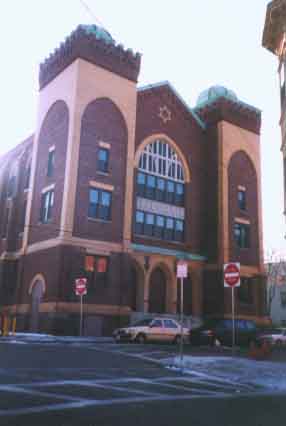
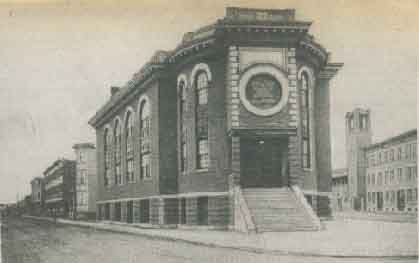
Walnut Street Shul
Congregation Hagudath Sholom is situated at
the corner of Walnut and Fourth Streets. This is the largest
congregation in Chelsea. It is co-operated with Beth Hamidrash
Hagodol which was destroyed in the Great Chelsea Fire of 1908. This
congregation is the oldest in Chelsea. It originally occupied the
building at 120 Winnisimmett St. Later the congregation outgrew the
Winnisimmett Street Synagogue and then built a magnificant structure
at the corner of Fifth and Poplar Streets which was destroyed by the
1908 fire. The present synagogue was immediately erected.
History of the Walnut Street Shul
In 1887, Jews gathered in the home of Monas Berlin to daven on
Shabbosos and Yamim Tovim. In time the minyan moved to new quarters.
It was called Congregation Ohabei Shalom. By 1901 the growing
congregation had enough funds to purchase property at the corner of
Walnut and Fourth Streets, which was to become the site of the Walnut
Street Shul. In the early 1900s Congregation Ohabei Sholom merged
with another group under the name Congregation Agudas Sholom. This
became the largest congregation in Chelsea and had almost completed a
new shul building on the Walnut Street site when it was destroyed by
fire in 1908. The destroyed building was rebuilt from a design by
non-Jewish architect Harry Dustin Joll, in 1909. The magnificent
structure was sometimes called the “Queen of Synagogues”
and is believed to have been the largest shul in New England at the
time. In the bylaws of 1909, the founding members declared that
“The organization shall carry the name of ‘Congregation Agudas
Sholom of Chelsea, Massachusetts’ and shall be conducted as strictly
Orthodox. The congregation shall consist of a school for learning, a
shul for prayer, and everything shall be carried out strictly under
the requirements of the Jewish religion and under the strict Jewish
laws and customs as govern other Orthodox congregations – and this
paragraph shall not be changed so long as there are seven members in
good standing who are satisfied to support the charter of this
congregation.” The ground floor of the shul contains a kitchen
and two battei medrash, a smaller one that was used for daily
davening and a larger one, where
Shabbos services usually took place. The men’s section of the main
shul is one flight up. The aron of the main shul stands 37.5 feet
high and is made of solid oak with carvings of animals and symbols
from the Torah. The women’s gallery is located on the third floor,
with a seating capacity nearly equal to that of the men’s section
downstairs. Together, the men’s and ladies’ sections on the second
and third floors can seat 1109 people.
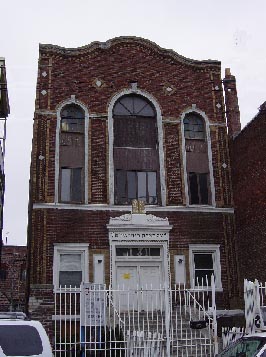
Congregation Linas Hatzedek Beth Israel or the “Chestnut
Street Shul was organized by immigrants from Kamen Kashirsky in the
Ukraine and the local carpenters association. It was disbanded in the
1980s and the building was sold to a local church which operates
there today.
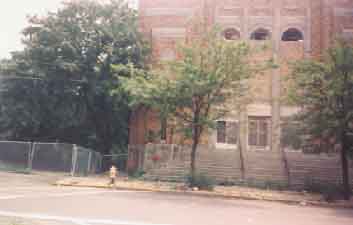
The Congregation Avas Achim Ansha Ephard was
situated on Everett Ave. at the junction of Elm St. The Congregation
was the second oldest in the city of Chelsea. It was organized in
1901. Shortly before the conflagration of 1908 a magnificent
synagogue occupied the present sight which was destroyed by the fire.
This synagogue was again destroyed in the fire of 1973.
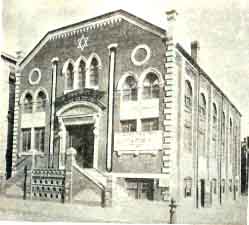
The Congregation Beth Hamidrash Hagodol is situated on Third St.
near the corner of Arlington St. This congregation conducted their
services for a number of years in some of the larger halls of the
city. In 1912 arrangements were made for the erection of a synagogue.
This edifice on Third St. is a result of those efforts.
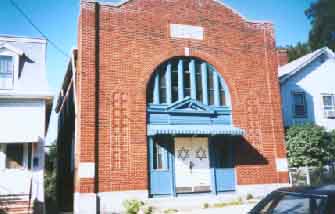
A house on Carmel St. provided the first
quarters for Congregation Shaare Zion, which was started in 1911.
A year later it moved around the corner to its
present location at 76 Orange St.
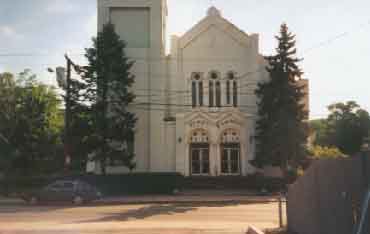
Jewish homes of worship in Chelsea have been, for the most part,
of the Orthodox branch of Judiasm. Of the some 20 synagogues that
have existed here during the past 100 years, the only exception has
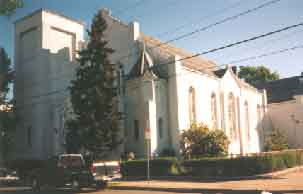
been Temple Emmanuel and its forerunner Temple Beth El. Temple Beth
El, which lasted but a few years, was dedicated in 1929. Its
conservative successor, Temple Emmanuel, was organized at the YMHA in
June 1937. It purchased its present Cary Ave. quarters from the First
Methodist Episcopal Church. It was formally opened that fall.
Temple Emmanuel – Cary Ave.
Young Mens Hebrew Association – YMHA
Update, October 2026: The Cary Avenue building, home to Temple Emmanuel since 1937, is now protected by a permanent historic preservation restriction approved by the City Council. Read the story.