While in Richmond, Virginia, President Abraham Lincoln made plans to
visit General Weitzel’s headquarters. No carriages were available to
transport him, so he decided to walk to the headquarters. The walk
was long and the president halted for a moment to rest. “May
de good lord bless you President Linkum!” said an old Negro,
removing his hat and bowing, with tears of joy rolling down his
cheeks. The President removed his own hat and bowed in silence. It
was a bow which upset the forms, laws, customs and ceremonies of
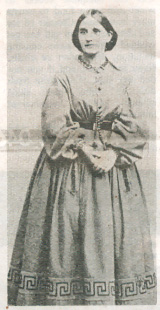
centuries of slavery. Helen Gilson, an army nurse from Chelsea, did a
deed in 1864 which upset the forms, laws, customs and centuries of
prejudice – just as her president had done.
Helen Gilson was born in Boston in 1836. She was a teacher until 1858
when throat trouble made it impossible for her to continuine
teaching. In 1858 she took a position as the governess to the family
of Frank Ball Fay, the 40 year old mayor of Chelsea. Hearing of the
defeat of the Union Army at Bull Run in the summer of 1861, Mayor Fay
and Gilson left for Virginia to aid the wounded soldiers and recover
the dead. For the next three years these two devoted their life to
caring of the sick and wounded soldiers. In 1864, Mayor Fay had to go
to Baltimore, Maryland and told Gilson and eight men to head to
Petersburg, Virginia and go to the front to be ready for the expected
battle, to help and assist the wounded soldiers. The fighting at
Petersburg went on for several days and for the first time some of
the 30 odd regiments of black soldiers in Grant’s Virginia armies
were engaged. Casualties were heavy as usual. The black wounded were
brought to a temporary facility at City Point which would soon become
a general hospital. A doctor wrote of the facility for the blacks: “It
was in no sense a hospital, than a depot for wounded men. There was
defective management and chaotic confusion. The men were neglected,
the hospital organization was imperfect, and the mortality was
consequently frightfully large. The severity of the campaign in a
marlarious country had prostrated many fevers and typhoid, in its
most malignant forms, was raging with increasing fatality.“
Gilson heard about the plight of the black soldiers, and
resolved to take action. None of her colleagues volunteered to assist
her, and they counseled her against her plan to organize the Colored
Hospital Service. Repugnantly, she went straight to Major General
Ambrose Burnside and confronted him with the deplorable crisis. She
employed all the tact, finesse and diplomacy of which a woman is
capable in order to get him to help. She was determined to overcome
prejudice and professional pride of the medical profession. Her
doctrine and practice always were instant, silent and cheerful. A
hospital for the black soldiers was finally organized. It consisted
of a square mile of tents. There was no cooking – stove and all
gruels, soups and tea were made by an open fire in the hot sun, where
the temperature was over 100 degrees. Gilson wrote, “It is
hot, and we are smothered by the dust. The day has been a hard one.
My men in the kitchen are down with fever. I have stood all day over
a raging fire making soups and gruels for the 200 men; the, later tea
for a hundred more, besides diet for the convalescents. Yet I have
found time to visit the wards, to read to the men, listen to
complaints and straighten out abuses. Poor fellows! They are full of
their ‘miseries,’ their special term for all pain. They are like
children in one’s hands.” Gilson had help from detailed
soldiers and some northern volunteers. She also had persons with
African descent, male and female, as cooks and nurses. Gilson’s
hospital for blacks took on a larger role than serving only the
troops. She sought out and cared for the black washerwoman working in
the hospitals and for families of other poor blacks. She gave them
rations and helped construct comfortable huts to live in.
During the last spring of the war, Gilson now 29, complained
that she “felt old.” She wrote, “I am tired,
tired, chronically tired. Tired to the very marrow of my bones.”
She was suffering from malaria and possible other maladies, but she
remained at her post until the fall of Richmond on April 2, 1865.
She left the army in July, going to Long Island, New York for the
rest of the summer. Recuperating, she returned to Chelsea in the fall
of 1865. She was again called on by Mayor Fay to assist him. He had
taken on the task of running an orphanage for 300 black children in
Richmond and he needed her help. Helen Gilson returned to Chelsea in
October of 1866. On October 11, 1866 she married E. Hamilton Osgood
in Chelsea. The marriage lasted just over one and a half years, for
Helen Gilson died in childbirth at Newton Corner Hospital on April
20, 1868, at 32 years of age. She had apparently been weakened by
malaria and other maladies of wartime service from which she did not
fully recover. The child did not survive. She was buried in a family
plot in the Woodlawn Cemetary in Everett.