In May 1631, the General Court of the Massachusett Bay
Colony granted to Thomas Williams the right to operate a ferry
between Winnisimmet and Boston, the first in the country. Service
began in June 1631 and ran continuously until 1917, a period of 286
years. Land travel to Boston was a day’s journey through Malden,
Medford, Watertown, Cambridge, Brighton, Brookline Roxbury and over
the neck. Thomas Williams passed away shortly after becoming
ferryman. William Stitson married Thomas Williams’ widow and
continued operation of the ferry. In 1634, the General Court ordered
that Winnisimmet shall belong to Boston. It was also ordered that the
Winnisimmet Ferry be granted to Mr. Samuel Maverick “to enjoy to
him and his heirs forever.” To continue operation , Maverick
granted William Stitson a life-time interest in the ferry. In 1635,
Maverick sold Winnisimmet and the ferry to Richard Bellingham. By
agreement with Bellingham, William Stitson sold his life-time
interest in the ferry for a life-time annuity of three pounds to be
paid bi-annually.
The original ferry landing was on the Maverick estate, now
Admiral’s Hill. Richard Bellingham moved the ferry landing easterly
of Broadway, about one-third the distance of it’s final landing slip.
at the foot of Winnisimmet Street. Many times the boats were
prevented from operating due to severe winds and storms. Some winters
were so harsh the harbor would be closed in by ice restricting any movement.
In the Boston Weekly News-Letter of Thursday November 26, 1741,
“Last Thursday one of the Winnisimmet Ferry boats turned upon
her side in a sudden gust of wind and filled with water, a newly
arrived French passenger was drowned. It was said he had a
considerable amount of gold on his person. Four other passengers were saved.”
Early 19th century sketch of the Chelsea Ferry
from Boston side
The Massachusetts General Court had regulated the operation of the
Winnisimmet Ferry by several acts through the years. In 1712, in
order to provide more speedy transportation, an act was passed
requiring a third boat with able, sober persons to row it. Again in
1749, the General Court declared the number of boats, assigned by law
for the Winnisimmet Ferry, was insufficient. It was therefore enacted
that four boats be provided and maintained, for the speedy
transportation of passengers. The act required two sober and able
bodied men, one to be white, to maintain the boats. Two of the boats
must be equipped with sails and two good oars. The other two boats
must be equipped with four good oars. The boats must be passing each
other continuously from sunrise to nine P.M. in the summer and from
eight A.M. to eight P.M. in the winter.
Chelsea Ferry Boston Slip Hanover Street, Boston
Lowney Choclate Co. on the left
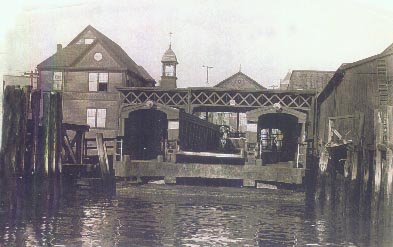
Chelsea Ferry Slip Winnisimmet Street, Chelsea
(Water side)
The ferry way or slip was an inclined plane of timber that
extended from high to low water mark. The boats were flat bottomed
and mostly propelled by oars. The boats were built to fit the wharf
so that carraiges could go aboard, no matter what the tide. Francis
B. Fay and a group of others formed the Winnisimmet Company in 1831.
On March 8th, the Company purchased the ferry and farm of one hundred
and thirty acres, from Thomas Williams at a cost of $22,500. An
additional $5,000 was paid to the City of Boston for a release of
claim for the landing in Boston. The same year the “Tom Thumb
” a small steamer, was introduced, being used for pleasure
parties only.
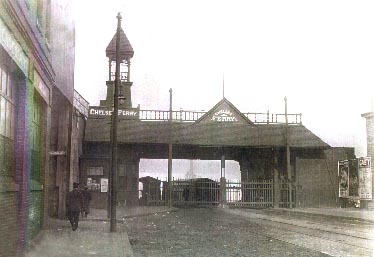
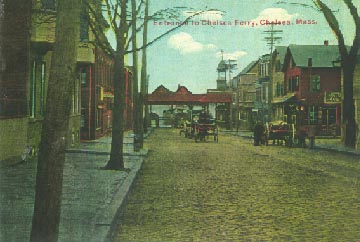
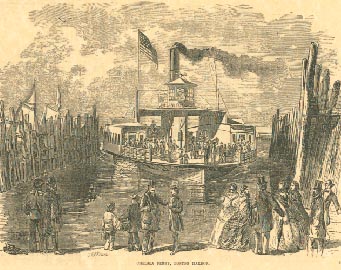
Entrance to Chelsea Ferry at the end of
Winnisimmet Street.
1631 – 1917
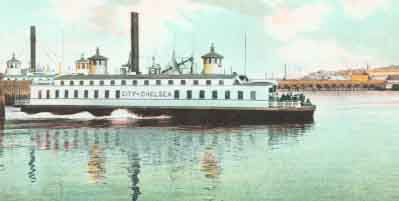
On July 25, 1832, two new steamboats the “Boston”
and the “Chelsea” built in Philadelphia at a cost of
$11,000 each, made their first run. The “Malden” was then
bought, followed by the “Mystic.” The “Bellingham”
with a passage through the center for carriages, was built in
Chelsea, but proved a failure. The “Winnisimmet” built in
1846, was used during the Civil War to transport soldiers and cannon
down the coast.
The installation of the larger and faster steam ferry brought a
tremendous increase in receipts but it was not to last. Along came
the steam railroad and the horse railway, soon followed by the
electric streetcars, all making faster traveling time over the bridge
or through the East Boston tunnel to Boston, and the motorized car
and truck all helped to put an end to the ferry.
Operating costs and maintenance were higher than receipts.
On January 18, 1917, the “City of Malden” made it’s regular
runs during the day and landed in Chelsea at 6:05 P.M. It’s tally for
the day: 125 foot passengers, 14 one horse teams, and 2 two horse
teams. Captain A. O. Small was in charge. The boat was made fast to
the drop, the water blown out of the boiler and the 286 year
operation of the Chelsea Ferry ceased operation.